Digital Transformation in the AI Era
Enterprises must embed AI into core workflows and governance to move beyond pilots and capture measurable operational value.

Key Takeaways
- Shift AI from pilots to operating models to capture measurable value.
- Fix content, workflow and governance foundations before scaling agents.
- Prioritize one document-heavy process for fast, low-risk wins.
- Use standards and controls to make AI deployment audit-ready.
- Build around governed content to improve search, automation and compliance.
Digital transformation in the AI era has moved beyond experimentation. Enterprises that still treat AI as a side project now face slower decisions, fragmented knowledge and rising operational debt. By contrast, leaders are embedding AI into core workflows, content operations and governance. This article explains what that shift looks like, why many programs stall, and how to move from pilots to production without betting the business.
Therefore, the priority is not another isolated demo. It is an operating model that connects content, workflows, controls and human oversight. For most organizations, that means starting with document-intensive processes, trusted retrieval and clear policy guardrails.
The shift from AI projects to AI operations
Digital transformation in the AI era is not about adding a chatbot to one channel. Instead, it is about redesigning how work flows across systems, teams and decisions. When AI becomes operational, it supports repeatable business outcomes rather than one-off experiments.
In practice, three structural changes separate operators from experimenters.
- Content becomes the substrate. Extraction, retrieval, summarization and agentic reasoning all depend on governed, accessible content.
- Workflows become adaptive. AI can route, validate and escalate work inside business guardrails.
- Compliance becomes computable. Policies move into the workflow and content layers instead of appearing only at audit time.
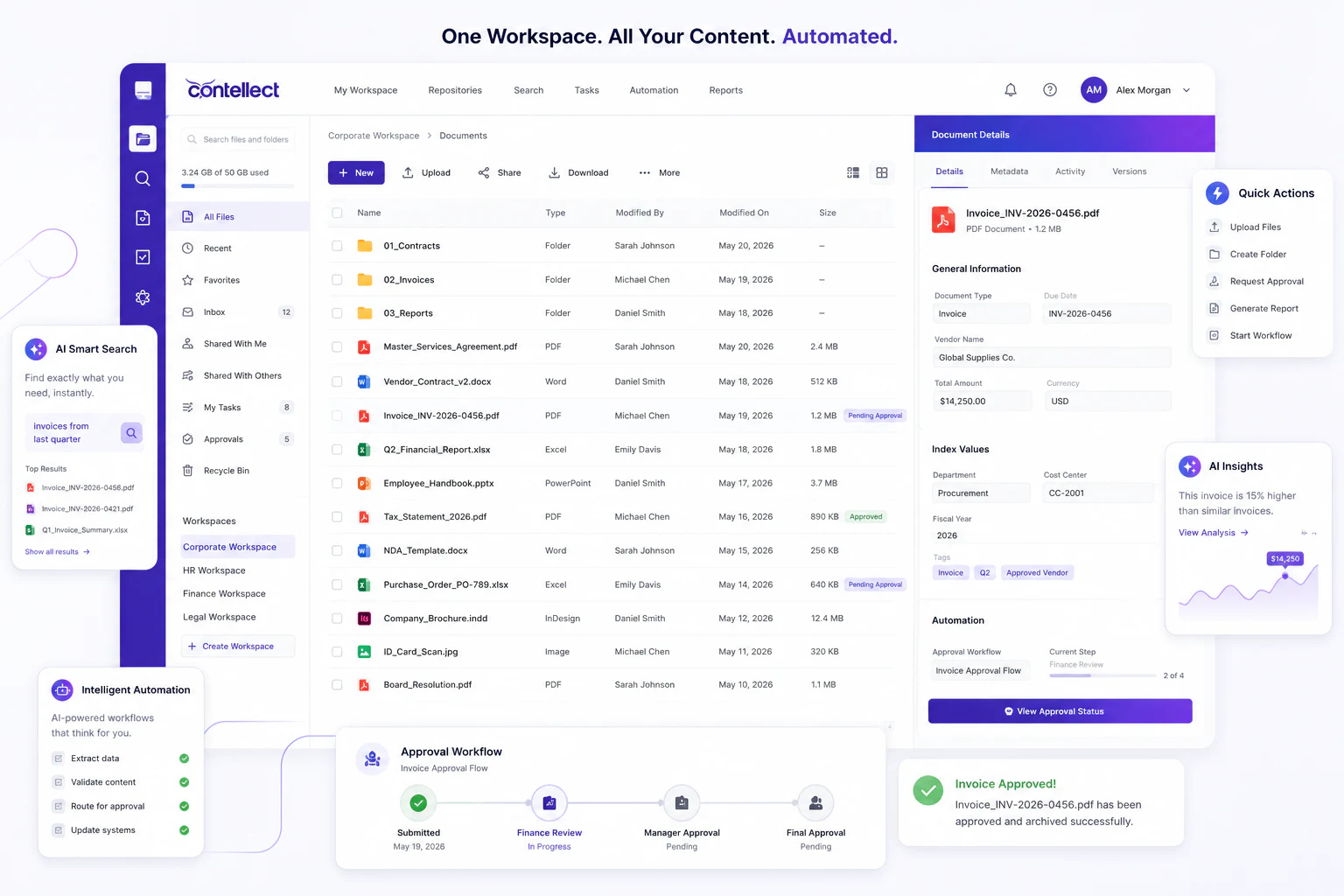
For example, a secure retrieval layer can ground answers on enterprise documents with citations. A document pipeline can classify incoming files, extract key fields and trigger approvals. In addition, policy checks can enforce retention, access and redaction before content reaches users or downstream systems.
Why digital transformation in the AI era often stalls
Many programs fail for reasons that pre-date AI. The strategy may be sound, but the foundations are weak. As a result, the organization cannot scale beyond pilots.
Fragmented content
Documents sit across SharePoint, file shares, email, legacy ECM and cloud drives. AI cannot reason over content it cannot reach or trust. Therefore, retrieval quality, automation accuracy and auditability all suffer.
Opaque processes
Approvals, exceptions and policy decisions often live in inboxes and tribal knowledge. That makes workflows hard to automate and even harder to govern. In addition, teams struggle to define where AI should act and where humans must approve.
Governance gaps
Ownership of classification, retention and access is often unclear. Legal, Risk and Security then slow deployment because they cannot verify controls. Frameworks such as the NIST AI Risk Management Framework, OWASP LLM Top 10 and ISO/IEC 42001:2023 help teams define roles, risks and evidence.
However, the fastest-moving enterprises do not wait for perfect conditions. They improve content, workflows and governance in parallel. That is the practical route to digital transformation in the AI era.
What an AI-era operating model looks like
When AI is operational, four patterns appear consistently across the business.
- People ask instead of search. Enterprise search returns grounded answers with citations.
- Documents arrive pre-processed. Files are classified, extracted, validated and routed automatically.
- Compliance runs continuously. Access, retention and redaction rules apply in real time.
- Agents handle multi-step work. Systems coordinate tasks across tools with human approval at key points.
For example, teams may use Microsoft Azure AI Foundry, AWS Bedrock or Google Vertex AI to orchestrate models and safeguards. Others may combine Databricks, Snowflake, NVIDIA NIM and Hugging Face for model serving, data pipelines and evaluation. The exact stack varies, but the design principles stay the same: grounded retrieval, observable workflows, policy enforcement and human oversight.
| Approach | Typical characteristics | Business impact | Main risk |
|---|---|---|---|
| Pilot-led AI | Isolated use cases, manual handoffs, weak governance | Local wins, limited scale | Tool sprawl and unclear ROI |
| Workflow-led AI | AI embedded in one process with controls and metrics | Faster cycle times and better accuracy | Integration complexity |
| Operating-model AI | Shared content layer, reusable controls, cross-team standards | Compounding enterprise value | Change management if ownership is weak |
Governance and standards that matter
Digital transformation in the AI era needs more than model performance. It needs evidence, accountability and control. Therefore, governance should be designed into the operating model from day one.
- EU AI Act Article 6 helps classify high-risk AI systems and obligations.
- GDPR Article 22 shapes decisions involving automated processing.
- NIST AI RMF 1.0 provides a practical risk management structure.
- ISO/IEC 42001:2023 supports an AI management system.
- ISO 27001 and SOC 2 support security and control assurance.
- MITRE ATLAS helps teams think through adversarial threats.
Furthermore, organizations should map AI controls to existing security and privacy programs. This reduces friction with Legal, Security and Internal Audit.
How to start digital transformation in the AI era
You do not need a massive transformation program to begin. Instead, start with a bounded workflow, clear metrics and reusable controls. The goal is to prove operational value quickly.
- Choose one high-volume process. Pick invoices, contracts, claims, onboarding or applications.
- Map the workflow. Identify inputs, decisions, exceptions, approvals and systems touched.
- Prepare the content layer. Classify documents, define metadata and set access rules.
- Deploy AI for extraction and routing. Keep humans in the loop for exceptions and material decisions.
- Ground retrieval on trusted sources. Use a secure knowledge base with citations and permissions.
- Measure outcomes. Track cycle time, straight-through processing, accuracy and exception rates.
- Codify controls. Document prompts, policies, evaluations and fallback paths.
As a result, you create a repeatable template for other teams. You also avoid the common trap of scaling an ungoverned proof of concept.
The cost of staying experimental
Enterprises that remain in pilot mode accumulate debt. First, they build capability debt because competitors gain operational experience with prompt design, evaluation and agent orchestration. Second, they build data debt because unmanaged content becomes harder to clean and govern later. Third, they build talent debt because strong AI operators prefer environments where AI is real, measured and trusted.
Therefore, the real question is not whether AI will reshape the business. It is whether the operating model can support the AI already in use and the agentic workflows coming next.