RAG and Grounded Answers
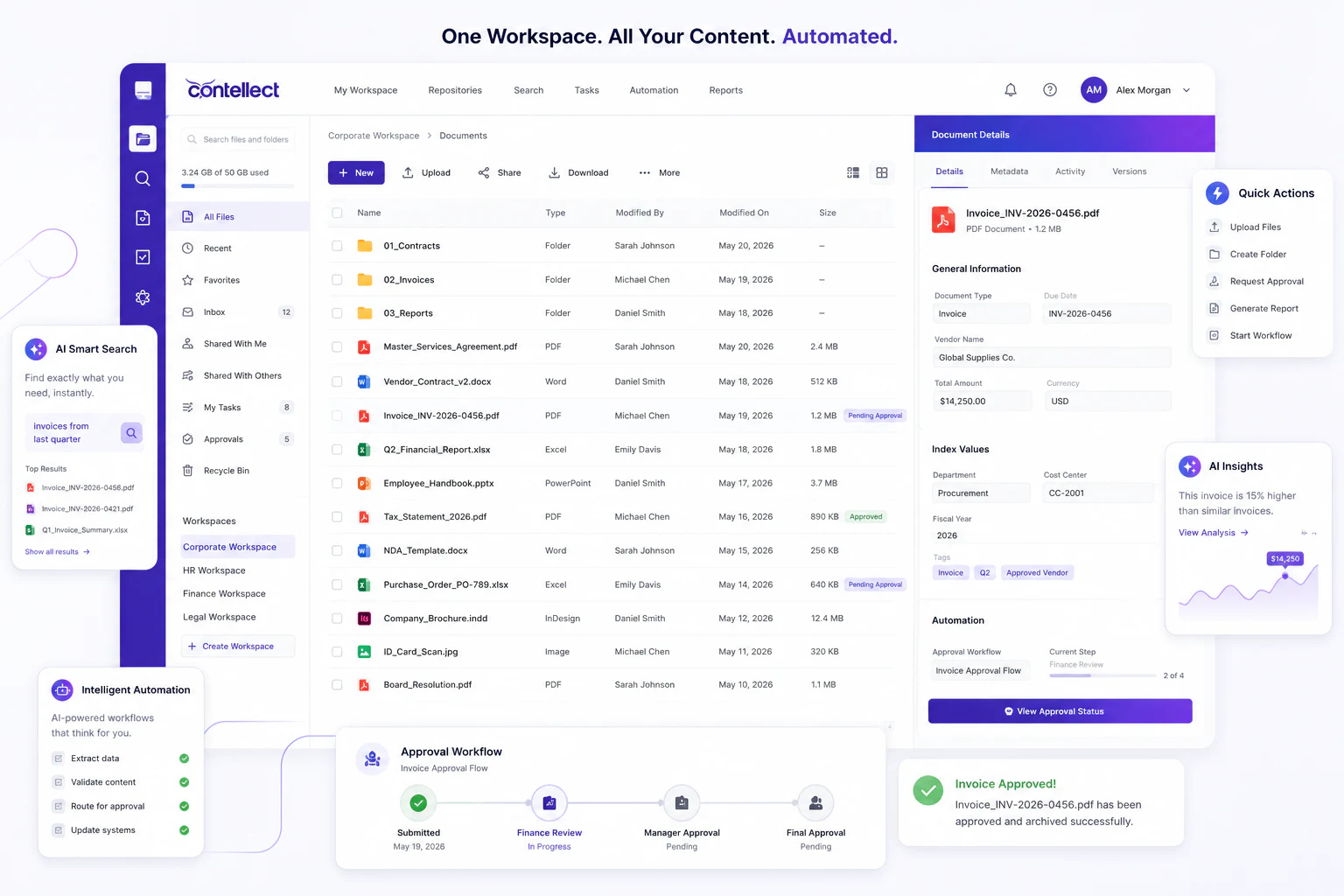
Retrieve relevant documents before generating answers so AI responses stay connected to approved enterprise knowledge.
Content intelligence, RAG, document processing, and semantic search that turn enterprise documents into trusted, governed answers.
Content intelligence uses AI to understand, classify, extract, search, summarize, and answer questions from enterprise documents and knowledge sources. Contellect One turns contracts, policies, records, invoices, cases, emails, forms, and archives into governed knowledge that teams can search, automate, and use safely with retrieval-augmented generation (RAG).
Contellect One frames content intelligence as a governed operating layer, not a generic AI feature. Each capability helps users ask better questions, retrieve trusted evidence, and automate document-heavy work.
Retrieve relevant documents before generating answers so AI responses stay connected to approved enterprise knowledge.
Classify documents, extract fields, validate information, and route low-confidence items for review.
Find content by meaning, context, metadata, permissions, and business relationships instead of folder location alone.
Keep answers, search, extraction, access, audit trails, and human review aligned with enterprise policy.
Contellect One creates a practical path from scattered enterprise content to governed AI experiences.
Ingest documents, emails, PDFs, scans, forms, records, knowledge articles, and repository content.
Classify content, extract metadata, identify entities, detect document types, and normalize key fields.
Apply permissions, retention context, sensitive-data controls, audit history, and review workflows.
Create full-text, semantic, metadata, and relationship indexes for secure retrieval.
Use RAG, knowledge bases, multilingual Q&A, and AI agents to respond from trusted sources.
Review usage, gaps, answer quality, exceptions, and process outcomes to refine knowledge models.
These use cases connect AI directly to the business documents, questions, and workflows that teams handle every day.
Ground AI answers in approved documents, policies, contracts, records, and knowledge bases with source context.
Extract names, dates, amounts, clauses, IDs, obligations, case details, and operational fields from documents.
Let employees ask plain-language questions and retrieve the most relevant documents and evidence.
Turn scattered policies, procedures, FAQs, manuals, and project knowledge into a governed AI knowledge layer.
Use controlled AI agents to summarize, compare, draft, route, and escalate document-driven work.
Support teams that need answers across languages while preserving source context and access controls.
AI responses are grounded in trusted enterprise content instead of unsupported general output.
Teams find policies, clauses, evidence, records, and insights without manual document hunting.
Extracted metadata and entities can launch workflows, validations, approvals, and integrations.
Permissions, audit trails, human review, and governance controls reduce operational AI risk.