CONTELLECT ONE / PLATFORM
Your data.
Your intelligence.
Your next move.
Five connected pillars. One platform for turning enterprise information into useful, governed action.
Capture what matters. Build trusted context. Put agents to work in applications shaped around your business.
Intelligence
Your sector. Your requirements. Your workflows.
FIVE PILLARS. DISTINCT ROLES.
Powerful on their own.
Better together.
Start with the business outcome.
Explore the capabilities that make it possible.
Built around the work you do.
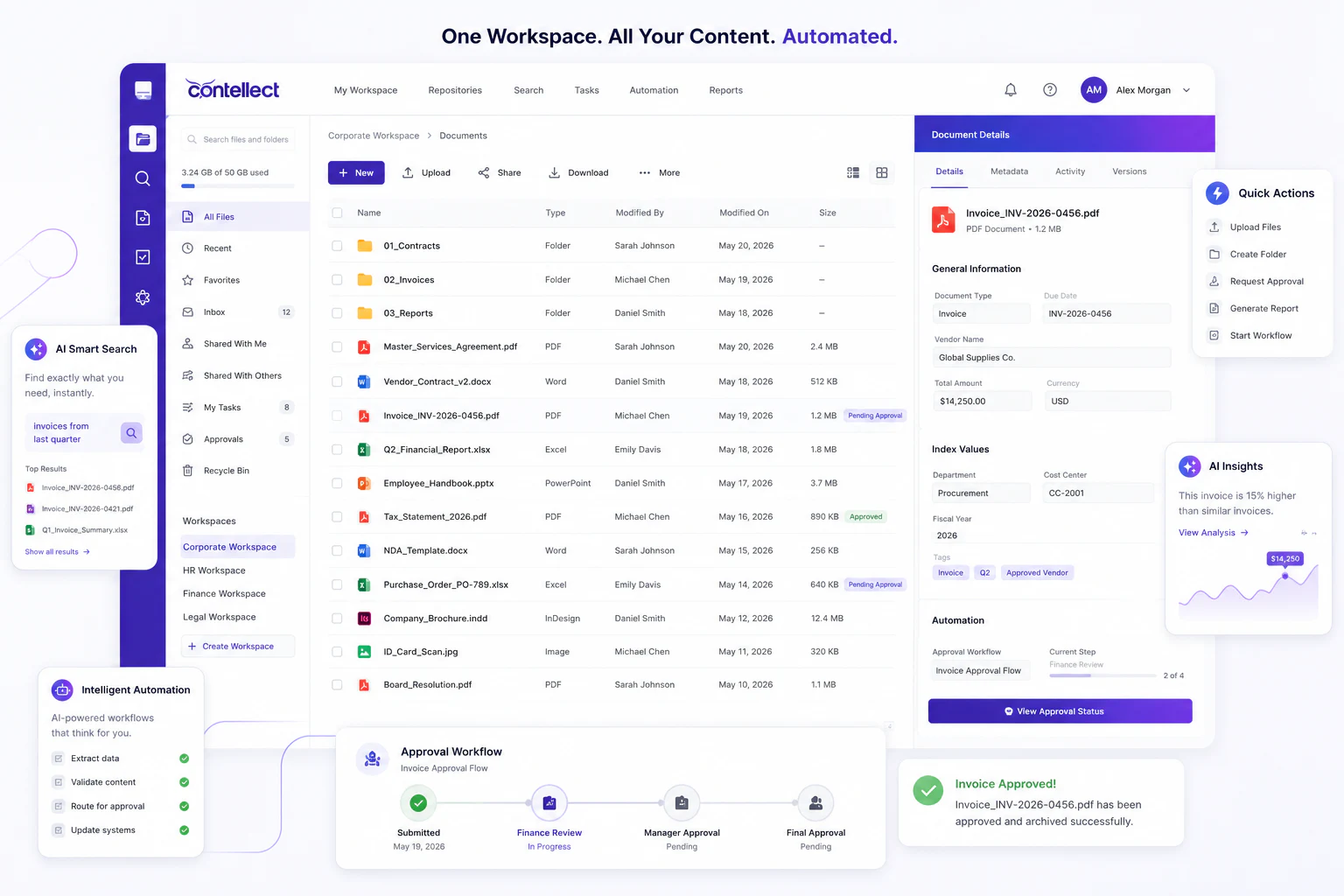
Bring platform capabilities together in sector-specific agentic applications, with your business rules and people in the loop.
Explore Application IntelligenceLending operations
Prepare application evidence for a credit reviewer.
Claims triage
Connect claims, policies, and supporting evidence.
Patient intake
Coordinate administrative records and intake tasks.
Citizen services
Bring requests, case history, and service rules together.
Asset maintenance
Connect inspection signals and maintenance knowledge.
Student onboarding
Coordinate enrollment documents and staff follow-up.
Contract review
Prepare source-linked issues for legal teams.
Employee onboarding
Organize records, requirements, and team tasks.
Turn incoming data into usable information.
Identify, extract, validate, and prepare information for the work ahead.
Explore this pillarIntelligent document processing
Extract useful fields from incoming documents and files.
AI classification
Identify information types and route them to the right process.
Data extraction
Read key values, tables, and supporting details.
Validation & review
Flag missing information and send exceptions to a person.
eForms
Collect structured information directly from people.
Document generation
Create documents using templates and approved data.
Multichannel intake
Bring incoming files and submissions into a shared flow.
Workflow handoff
Pass validated information to connected business processes.
Trusted information. Throughout its lifecycle.
Keep business records organized, accessible, and governed.
Explore this pillarContent services
Organize enterprise content in a connected workspace.
Records management
Manage business records throughout their lifecycle.
Metadata & organization
Connect information with consistent tags and business context.
Access controls
Define who can view and work with information.
Version history
Keep changes and previous versions connected.
Collaboration
Support shared work, reviews, and team handoffs.
Retention & compliance
Apply retention rules and support compliance processes.
Audit trails
Follow activity and decisions across the record lifecycle.
Different data. One context for AI.
Connect multimodal information into relevant, permission-aware context for agents.
Explore this pillarMultimodal knowledge
Connect text, images, tables, records, and operational signals.
Connected sources
Bring knowledge from business systems into context.
Context assembly
Select relevant information for the task at hand.
Semantic retrieval
Find information by meaning and business context.
Grounded answers
Keep responses connected to supporting evidence.
Source references
Help people trace an answer back to its sources.
Permission-aware context
Respect access boundaries when assembling knowledge.
Agent knowledge
Provide a reusable knowledge foundation for different agents.
From understanding to coordinated action.
Put agents, business systems, and people into a controlled workflow.
Explore this pillarAI agents
Support defined business tasks with relevant context.
Workflow orchestration
Coordinate steps, dependencies, and business rules.
Process intelligence
Surface process information that helps teams identify next steps.
Human approvals
Route consequential steps to the appropriate reviewer.
System integration
Connect tasks with enterprise applications and services.
Task routing
Send work and exceptions to the right team.
Action guardrails
Define permitted actions and escalation paths.
Execution history
Keep workflow events, decisions, and outcomes traceable.
SEE THE CONNECTION
One onboarding request.
Every pillar plays a part.
A simple example of how an application brings the platform together, with people in control.
Receive
Capture & UnderstandRead the forms and identify missing information.
Organize
Manage & GovernConnect records, permissions, and version history.
Understand
Knowledge & Agent PlatformRetrieve the relevant onboarding requirements.
Coordinate
Agentic Process IntelligenceAssign tasks and route exceptions to the right reviewer.
Employee onboarding, connected.
A complete case, clear next steps, and a reviewer who owns the decision.
↗BUILT FOR YOUR ENVIRONMENT
Connected to your systems.
Grounded in your rules.
Keep the tools, teams, and governance that matter to your business part of the solution.
Explore content intelligenceEnterprise application integration
Connect business applications, data sources, and services.
Collaborative workspaces
Bring people, records, and shared tasks together.
Cloud architecture & scalability
Plan the platform around your deployment requirements.
Process automation
Coordinate repeatable work across business systems.
START WITH YOUR USE CASE
What could your next move be?
Explore how the five pillars fit your data, teams, and business processes.
A CLEARER PICTURE
Platform questions,
answered.
What is the Contellect One platform?
Contellect One connects five pillars: Application Intelligence, Capture & Understand, Manage & Govern, Knowledge & Agent Platform, and Agentic Process Intelligence. Together they help teams turn incoming data into governed knowledge and coordinated business workflows.
How does Application Intelligence use the other four pillars?
Application Intelligence brings capture, content governance, contextual knowledge, and process orchestration into a business-specific workflow. For example, an onboarding application can collect forms, manage records, retrieve policy guidance, and coordinate staff approvals.
Does the platform work with more than documents?
The Knowledge & Agent Platform brings documents together with images, tables, structured records, and operational information. Available sources and integrations depend on the implementation.
Where do people stay involved in agentic workflows?
Teams define permissions, business rules, and approval paths. Agents can prepare evidence and proposed actions, while designated reviewers handle steps that require human judgment or authorization.
Can we start with a single capability?
You can begin with a focused use case and connect additional platform capabilities as requirements grow. Deployment scope, integrations, and governance requirements are agreed during solution design.