C1
Focused platformContellect One
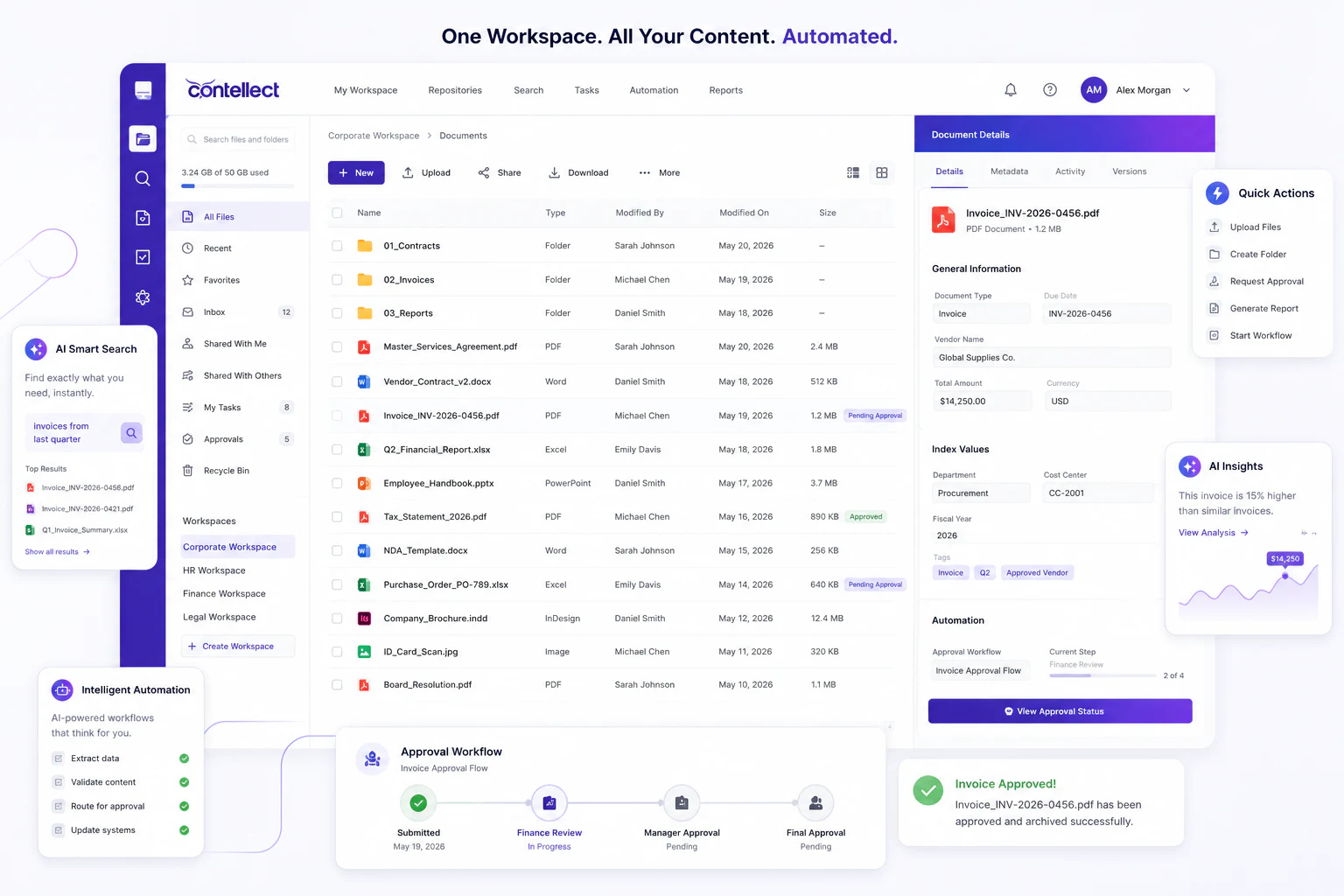
Contellect One is the focused OpenText alternative for organizations that want content management, AI-powered intelligence, enterprise search, and workflow automation in one secure workspace.
Competitor information reviewed September 1, 2026
The short answer
Contellect One brings documents, AI search, data extraction, governance, and workflows into one focused workspace. OpenText provides a broader portfolio built from multiple content products and services.
This difference affects implementation scope, administration, user experience, and how quickly teams can move from enterprise content to business action.
At a glance
Start with the clearest differences in platform scope, AI, automation, and implementation.
Unified content, AI, and workflow automation in one secure workspace.
Broad information management for complex enterprise requirements.
One focused platform connecting content, intelligence, people, and processes.
A portfolio of content products, modules, and services.
Built-in classification, extraction, governed search, insights, and AI workflows.
Content Aviator capabilities across supported OpenText products and applications.
Document processing, validation, tasks, approvals, and actions in one workspace.
Workflow, case management, and process automation across the portfolio.
Start with one priority use case, prove value, and expand in phases.
Scope depends on the products, integrations, services, and deployment model selected.
The icons distinguish the two columns. They do not indicate that one capability is universally good or bad.
Best-fit guidance
Choose Contellect One when
OpenText may fit when
Decision framework
Identify the repositories, AI capabilities, workflows, records controls, and integrations required on day one.
Test citations, permission enforcement, model controls, confidence handling, auditability, and human review.
Confirm whether each connection is read-only, bidirectional, event-driven, workflow-aware, and supported.
Validate classification, retention, legal hold, permissions, audit history, and disposition requirements.
Define who configures, tests, operates, upgrades, and supports every required platform component.
Reconcile content, versions, metadata, permissions, links, audit history, and retention state.
Migration methodology
A phased migration keeps business continuity, security, validation, and legacy retirement visible from the first assessment through final acceptance.
Discuss your migrationInventory repositories, content, versions, metadata, permissions, policies, integrations, and customizations.
Define target document types, relationships, security, retention, workflow states, and transformation rules.
Use representative content, including restricted records, old formats, large files, and difficult exceptions.
Reconcile counts and checksums, test search and access, confirm policies, and record business acceptance.
Move in controlled waves with clear cutover, coexistence, exception handling, and rollback plans.
Decommission legacy services only after operational, recovery, audit, and retention obligations are met.
Proof of concept
Use representative documents, permissions, integrations, workflows, and acceptance criteria. Score the configured result, not the generic product tour.
Select two or three document-heavy processes.
Include difficult scans, restricted records, and exceptions.
Test extraction, search, citations, permissions, and routing.
Measure user steps, accuracy, configuration, and administration.
Review production architecture, responsibilities, timeline, and scope.
Transparent sourcing
Competitor information was reviewed on September 1, 2026. Products and packaging can change, so confirm current requirements, licensing, availability, and implementation scope directly with each vendor.
OpenText and its product names are trademarks of their respective owner. They are used only to identify the products discussed. Contellect is not affiliated with or endorsed by OpenText.