Aging Content Management for AI Readiness
Learn how to govern aging enterprise content by value, risk, and use so it stays searchable, compliant, cost-efficient, and ready for AI.

Key takeaways
- Aging content should be governed by value, risk, policy, and likely use, not by file age alone.
- Keeping everything increases cost, search noise, security exposure, and the amount of low-quality content available to AI.
- Moving old files into an inaccessible archive lowers immediate storage pressure but creates retrieval and modernization problems.
- Intelligent archiving keeps approved content searchable and governed while applying the right storage tier and retention action.
- AI readiness depends on content quality, permissions, provenance, classification, and lifecycle controls, not simply on having more data.
Aging content management is the process of identifying inactive enterprise information, understanding its business and compliance context, and deciding whether to retain, tier, archive, remediate, or delete it. A strong program keeps valuable content accessible to authorized users and AI systems while reducing cost, risk, duplication, and search noise.
Enterprise repositories rarely become cleaner by themselves. Documents, emails, scans, reports, presentations, exports, and collaboration files accumulate across content platforms, shared drives, cloud storage, business applications, and personal workspaces. Some remain valuable. Others become duplicates, obsolete drafts, unsupported formats, or records kept beyond their required period.
The difficult part is not finding old files. It is determining what those files mean now.
A timestamp can show when a file changed, but it cannot tell you whether the file is an official record, subject to legal hold, the only evidence of a past decision, safe to expose to an AI assistant, or a redundant copy that should have been removed years ago. Effective aging content management adds that missing context.
What counts as aging content?
Aging content is information that has moved out of regular use but has not yet reached a clear lifecycle decision. It often includes:
- completed project files and closed case records;
- superseded policies, procedures, contracts, and templates;
- former employee content and abandoned collaboration spaces;
- historical email, reports, and business exports;
- scanned records stored without complete metadata;
- duplicate and near-duplicate files across repositories;
- content in legacy applications approaching retirement;
- material whose retention owner or policy is unknown.
Aging content is not automatically useless. Historical information may support an audit, customer inquiry, legal matter, trend analysis, model evaluation, or a future decision. The objective is to separate content with continuing value from content that creates cost and exposure without a defensible purpose.
Why the two common approaches fail
Most organizations drift toward one of two strategies: keep everything in place or move old content into a separate archive. Both solve an immediate operational problem, but neither creates a complete governance model.
| Approach | Immediate benefit | Long-term problem |
|---|---|---|
| Keep everything in primary systems | No deletion decision and familiar user access | Higher cost, noisy search, unnecessary access exposure, duplicate content, and unclear retention |
| Archive by age alone | Lower demand on primary storage | Valuable content can become difficult to find, retrieve, govern, migrate, or use with AI |
| Govern by context and policy | Content follows an explainable lifecycle decision | Requires classification, ownership, policy mapping, and measured operational controls |
Keeping everything creates hidden risk
“Just in case” retention feels safe because nothing appears to be lost. In practice, it delays decisions while the information estate becomes harder to understand. Search results fill with outdated versions. Sensitive content remains accessible longer than necessary. Discovery scope expands. Users stop trusting the repository and create more local copies, which makes the problem worse.
AI magnifies this weakness. A retrieval system can surface an obsolete policy as confidently as the current one if version status, authority, and effective dates are missing. More content does not automatically produce better answers. Governed, relevant content does.
Age-based archiving removes context from the decision
An age threshold is useful for identifying candidates, but it is not enough to decide their future. A five-year-old executed agreement and a five-year-old draft presentation may have completely different legal, operational, and analytical value.
Traditional archives also tend to become separate silos. If retrieval requires an IT ticket, if permissions are not synchronized, or if metadata is stripped during movement, users lose confidence in access. The organization has reduced one storage bill by creating a new knowledge and migration problem.
The risks of unmanaged aging content
Search becomes less reliable
Duplicate, obsolete, and poorly classified content pushes relevant material down the result list. This affects keyword search, natural-language search, retrieval-augmented generation, and any automation that depends on finding the right document.
Retention becomes difficult to defend
Over-retention and premature deletion are opposite failures caused by the same weakness: the organization cannot consistently connect content to a policy, trigger, owner, or hold. Records management provides the schedule, while aging content operations apply it to the actual estate.
Security exposure grows quietly
Old content can preserve personal data, commercial terms, credentials, exports, and permissions inherited from abandoned workspaces. A file that is rarely opened can still be broadly accessible. Age does not reduce sensitivity.
Legacy systems become harder to retire
Applications remain operational because nobody knows what information inside them must be migrated, preserved, or deleted. A content inventory and defensible disposition process can reduce migration scope and make retirement decisions clearer.
AI initiatives inherit weak information quality
An AI service needs authoritative sources, usable text, dependable metadata, current permissions, provenance, and clear version status. Feeding it an unmanaged archive can increase contradictory answers, expose restricted material, and make citations difficult to verify. The foundation is information governance, not an unfiltered content dump.
A five-step framework for intelligent aging content management
Map repositories, owners, formats, age, activity, permissions, duplicates, and policy gaps.
Identify record class, sensitivity, business purpose, authority, lifecycle status, and AI suitability.
Apply retention, legal hold, remediation, storage tier, access, and disposition rules.
Keep searchable metadata, permissions, provenance, and controlled retrieval available.
Track decisions, exceptions, savings, retrieval outcomes, policy coverage, and AI readiness.
1. Discover the real content landscape
Start with evidence rather than assumptions. Inventory repositories and collect signals such as file type, size, owner, creation and modification dates, last access, permissions, duplicate hashes, language, location, and application dependency.
Discovery should also expose what cannot yet be decided. Unknown ownership, corrupted files, encrypted containers, unsupported formats, and missing metadata belong in an exception queue. Hiding uncertainty inside a general archive category does not remove it.
2. Classify by context, not only by location
Repository and folder names are unreliable classification systems. The same contract may appear in procurement, legal, finance, email, and a shared project folder. Classification should identify what the content is, whose process it supports, whether it is authoritative, what it contains, and which policy applies.
Automated document classification can accelerate this work, but high-impact decisions need confidence thresholds, validation rules, and human review paths. A low-confidence invoice classification is an operational exception. A low-confidence legal-hold decision is a risk event.
3. Make an explainable lifecycle decision
Each content group should reach one of a small number of controlled outcomes:
- retain in place when active access, application behavior, or policy requires it;
- move to a lower-cost tier when access is infrequent but retrieval must remain available;
- preserve when long-term authenticity, format sustainability, or historical value matters;
- remediate when metadata, ownership, format, permissions, or version status is incomplete;
- restrict when sensitivity or inherited access creates exposure;
- delete defensibly when retention has expired, no hold applies, and approval is recorded.
The decision record should show the rule, evidence, approver, date, exception status, and resulting action. That audit trail is as important as the storage movement itself.
4. Preserve user and AI access without creating another silo
Archived content should remain discoverable to authorized users through familiar search and business processes. The organization should preserve stable identifiers, metadata, access controls, retention state, legal holds, provenance, and a tested retrieval path.
For AI use, content also needs an explicit eligibility decision. Not every retained file should enter an AI index. Eligibility can depend on authority, currentness, sensitivity, text quality, language, duplicate status, and whether the system can enforce source permissions during retrieval. Retrieval-augmented generation works best when the retrieval layer can distinguish an approved source from an obsolete copy.
5. Measure outcomes and govern exceptions
Do not measure success only in terabytes moved. A program can transfer large volumes and still leave policy gaps, failed retrievals, or inaccessible records. Use a balanced scorecard:
| Outcome | Useful measures |
|---|---|
| Cost | Primary storage reduced, duplicate volume removed, legacy applications retired |
| Governance | Percentage classified, percentage mapped to policy, approved dispositions, unresolved exceptions |
| Access | Retrieval success rate, average retrieval time, user self-service rate, permission accuracy |
| Risk | Overdue retention actions, hold conflicts, excessive access, sensitive content remediated |
| AI readiness | Authoritative content coverage, OCR quality, metadata completeness, eligible content indexed, citation success |
Review exception trends, not just totals. If the same repository repeatedly produces unknown owners or missing retention rules, the upstream process needs repair.
How to decide what AI should use
AI-ready content is not simply content that has been digitized or indexed. Before including an aging collection in enterprise search or a generative AI service, ask:
- Is it authoritative? Drafts, superseded versions, and convenience copies should not outrank approved records.
- Is it permitted? Retrieval must enforce the source system’s access rules and any additional AI-use restrictions.
- Is it understandable? Text, metadata, language, structure, dates, and document relationships need to be usable.
- Is it traceable? Answers should point back to a stable source with provenance and lifecycle status.
- Is it current enough for the question? Historical content may be valuable for trends but unsafe for current policy guidance.
- Can it be withdrawn? Retention expiry, legal decisions, corrections, and access changes must propagate to the AI index.
This creates a governed knowledge layer instead of a one-time ingestion exercise. Enterprise search and AI retrieval then operate on a controlled content set that can change as policy and business context change.
What to look for in a content management platform
An aging content program usually spans multiple repositories, so platform evaluation should focus on control across the estate. Look for capabilities that can:
- inventory content across cloud, on-premises, and business application repositories;
- detect duplicates, obsolete versions, sensitive information, and ownership gaps;
- classify at file level using metadata and content context;
- map content to retention rules, legal holds, and disposition workflows;
- apply storage tiering without breaking search, permissions, or identifiers;
- preserve audit history and approval evidence;
- support self-service retrieval with clear service levels;
- govern which content is eligible for enterprise AI and search;
- measure policy coverage, cost reduction, access, and exception trends.
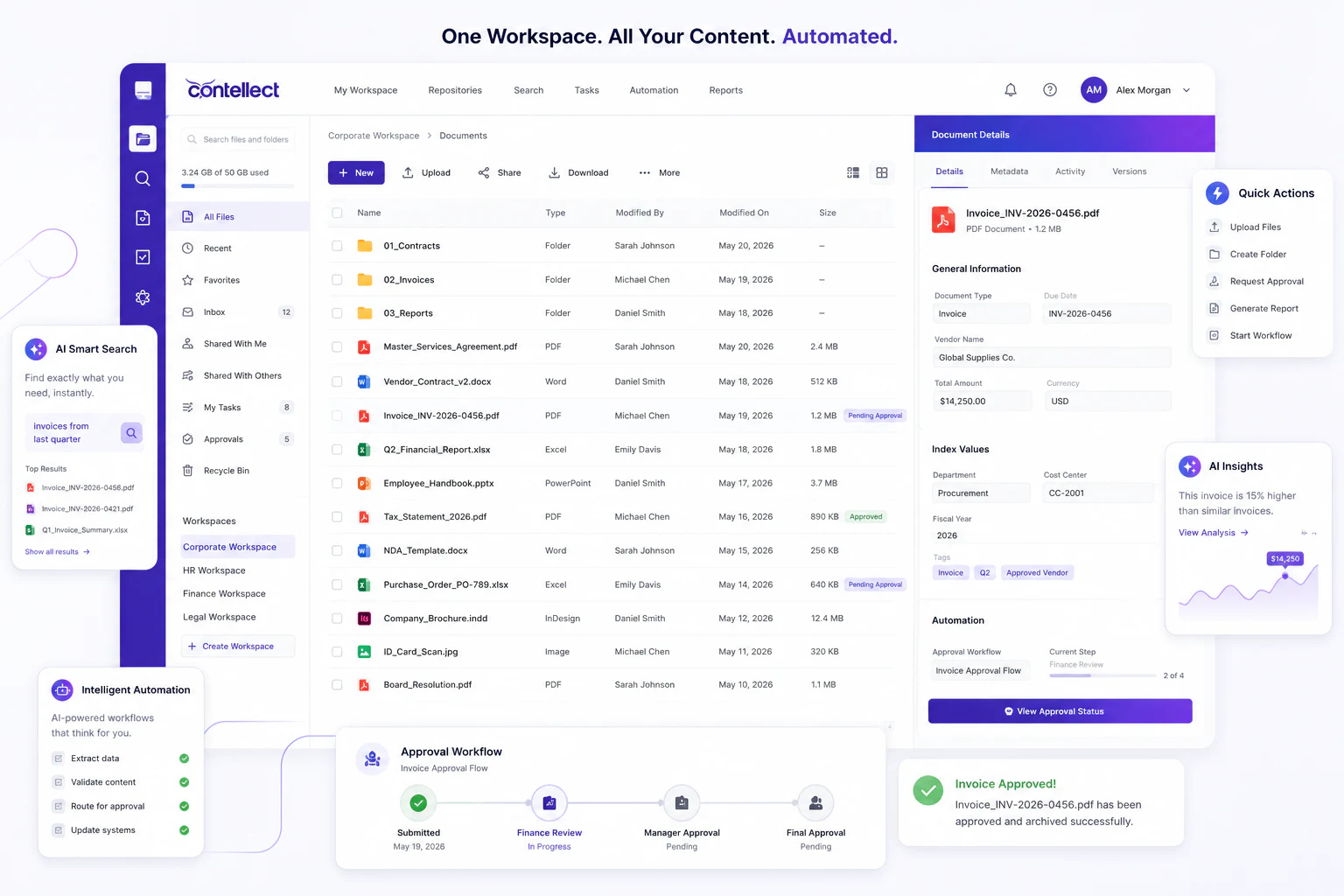
Contellect One connects document and content management, intelligent classification, records controls, enterprise search, and AI-ready retrieval in one governed content lifecycle. That makes aging content a managed information asset rather than a growing storage category.
A practical starting point
Choose one repository or one high-value content class. Baseline its volume, duplication, ownership, retention coverage, access patterns, and retrieval performance. Define the permitted lifecycle outcomes, test them on a representative sample, and review exceptions with records, legal, security, IT, and business owners.
Then run a controlled proof of value. Measure how much content reached a defensible decision, how reliably users could retrieve retained material, how many policy gaps were exposed, and what portion became suitable for governed AI use. Expand only after the decision logic and audit evidence work in practice.
The result should not be a colder archive. It should be a smaller, clearer, searchable, and policy-controlled content estate that supports both today’s operations and tomorrow’s AI services.