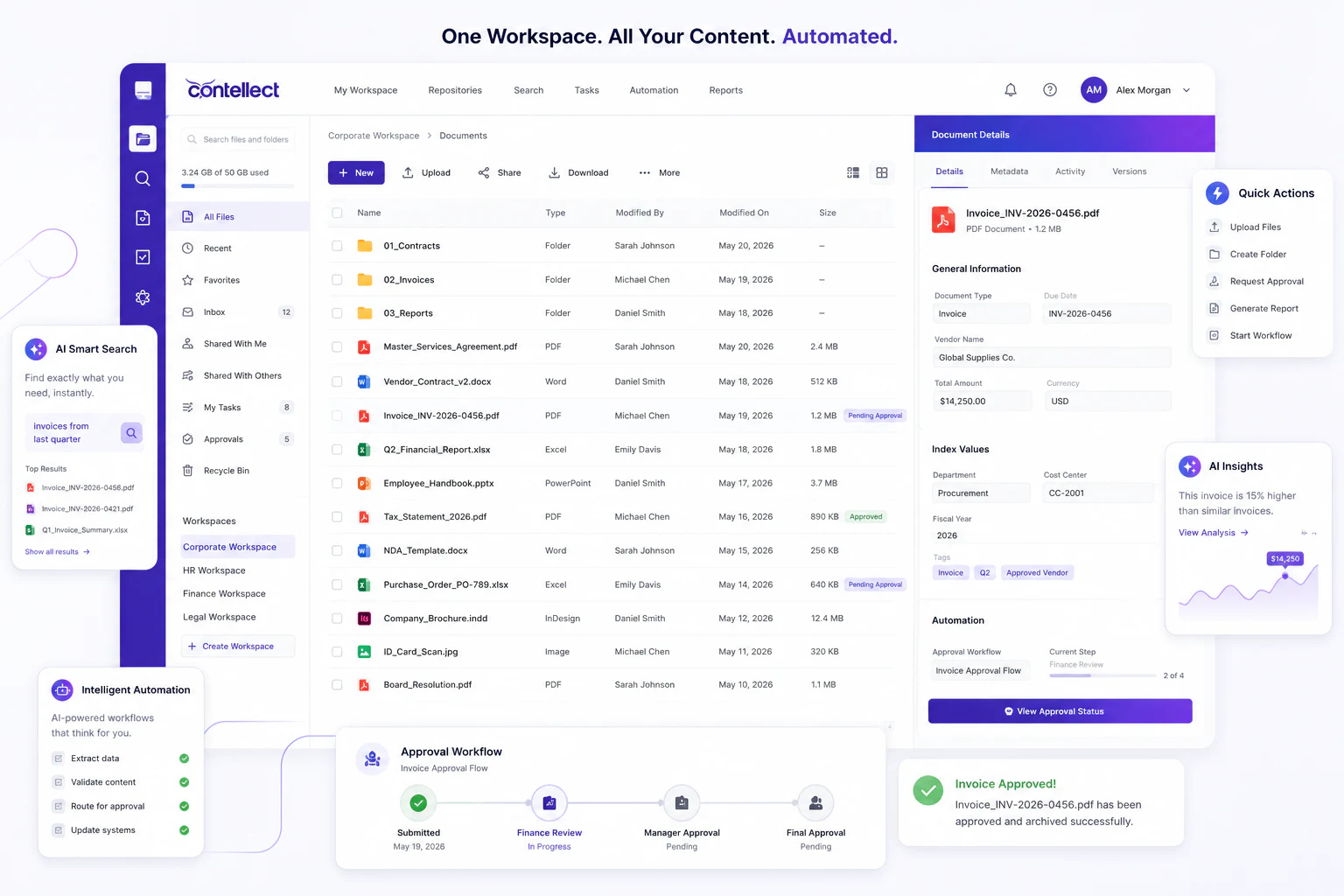
AI Agents: Orchestrating Business Tasks
How AI agents support customer onboarding, insurance and government services through orchestration, human approval and governed unstructured data.

A new business customer submits an account application. The relationship manager has the form. Operations has the company documents. Compliance needs ownership evidence. A revised attachment arrives by email after the first review has started. Nobody is waiting for a better paragraph of AI-generated text. They are waiting for the case to move forward with the right evidence.
This is where AI agents in business become useful. An agent can identify what has arrived, compare it with what the process requires, retrieve a relevant policy, prepare a targeted follow-up and hand a documented exception to the right person. It can reduce the work between systems as well as the work inside a document.
But completing individual tasks is only part of the problem. A bank must know whether the customer file is ready for a decision. An insurer must know which policy wording applied on the date of loss. A public authority must be able to explain how a submission was assessed. In each case, reliable automation depends on three things working together: informative evidence, coordinated execution and accountable decisions.
What human tasks can AI agents perform?
An AI agent is a system that uses a model and tools to pursue a defined objective, adjusting its next step in response to information and results. In an enterprise, those tools might retrieve a customer record, inspect a document, check a case status or submit an approved update. A useful objective is specific: “Prepare this application for review and identify unresolved evidence.” An instruction to “handle onboarding” leaves too much authority undefined.
The best starting point is the work a person performs repeatedly while preparing a decision: collecting information, comparing sources, applying a checklist, explaining a discrepancy and assembling the next action. A role such as underwriter or compliance officer contains many such tasks, but also carries judgment and accountability that cannot be reduced to a prompt.
| Human task | Agent contribution | Boundary to enforce |
|---|---|---|
| Read and organize a case | Classify attachments, extract fields and link evidence. | Flag unreadable pages and uncertain matches. |
| Check requirements | Compare the file with a versioned checklist and approved policy. | Do not interpret missing evidence as a pass. |
| Analyze discrepancies | Explain conflicting names, dates, amounts or clauses with citations. | Separate observation, inference and verified fact. |
| Prepare correspondence | Draft a specific request for missing information. | Apply recipient, disclosure and sending permissions. |
| Recommend a next step | Prepare options, supporting evidence and unresolved questions. | Escalate outside the delegated scope. |
| Update an application | Execute an authorized transaction through a controlled tool. | Check approval, prevent duplicates and verify the result. |
Agent, chatbot or workflow: choose for the task
A chatbot can explain an onboarding checklist. A deterministic workflow can route an application once required fields are present. Robotic process automation (RPA) can enter those fields into a legacy application. An agent can help when the next step depends on interpreting varied documents or resolving incomplete context.
These approaches can coexist. Anthropic’s engineering guidance distinguishes workflows with predefined execution paths from agents that dynamically direct their use of tools. It recommends beginning with the simplest suitable approach. The practical implication is to reserve flexible reasoning for the parts that need it, while enforcing mandatory sequence and authorization in code. Source: Anthropic, Building effective agents.
Why unstructured data is the foundation of reliable agents
Business systems store fields. Business cases depend on evidence. The explanation for a field may sit in a signed form, policy endorsement, inspection report, email attachment or scanned certificate. An agent that sees only the field can miss the qualification that changes its meaning.
Consider a company name extracted from a registration certificate. The text may be accurate, yet the certificate may belong to a different entity, be superseded by an amendment, or omit a page identifying the authorized signatory. Optical character recognition (OCR) solves the reading problem. It does not, by itself, solve identity, completeness or authority.
A fact needs its context attached
Original document, page location, version and capture date.
Field definition, entity relationship and relevant business purpose.
Quality checks, effective dates, contradictions and validation status.
Access permissions, permitted use, retention and review history.
Illustrative evidence record. A readable value is not automatically a verified fact.
An informative content pipeline preserves these connections through six stages: capture the original; classify its type; extract relevant values; validate them against rules and reference sources; associate them with the correct case; and expose them through permission-aware retrieval. Low-quality scans, ambiguous entity matches and inconsistent values need explicit exception states.
Retrieval-augmented generation (RAG) can supply relevant source passages to a model. Relevance alone is insufficient. Retrieval must also respect the user’s access, select the policy version applicable to the case, retain the source location and detect when essential evidence is absent. A vector index is a retrieval mechanism; it is not the system of record or the authority for a decision.
Permissions should travel with extracted text, embeddings, caches and summaries. A restricted document does not become unrestricted when it is summarized. Likewise, document instructions are untrusted content: a sentence telling an agent to bypass a check must never acquire the authority of an application policy.
This information discipline is the subject of our AI data readiness guide. Intelligent document processing supplies classification, extraction and validation; information governance determines how the evidence may be used throughout its lifecycle.
What does AI agent orchestration actually do?
AI agent orchestration coordinates responsibility, sequence, shared case state, tools, approvals and recovery. It answers operational questions: which task runs next, what evidence it needs, who may authorize the resulting action, and what happens if a system fails.
A conversation among agents is not a sufficient control system. Production orchestration needs durable state outside the conversation, so a case can resume after an interruption without forgetting an unresolved exception or repeating a completed action. The coordinator may use AI to propose work, but authorization checks must remain enforceable independently of that proposal.
One case. Coordinated work. Explicit authority.
The orchestrator owns progress. Each specialist owns a bounded task.
Intake
Identify documents and missing items.
Evidence
Extract, reconcile and cite sources.
Policy
Retrieve applicable rules and flag gaps.
Analysis
Prepare a reasoned recommendation.
Missing evidence or a failed check returns the case to review. A changed case can invalidate its approval.
These are logical responsibilities, not a requirement to deploy four separate models. One agent with constrained tools may be sufficient. Separate specialists are useful when tasks require different permissions, source collections or evaluation criteria. They also create more handoffs and opportunities for inconsistent conclusions.
Controls that turn a demonstration into an operating process
Store the case identifier, current evidence version, required checks and completion status in the workflow system. Give each tool the minimum permissions needed. Define deadlines and escalation owners so exceptions do not become a silent backlog.
For actions that change records, use an idempotency key or equivalent duplicate-prevention mechanism. If the account system times out after accepting an update, the orchestrator should check the transaction status before retrying. A missing response does not prove that nothing happened.
Record the evidence references, policy version, tool calls, validation results, concise decision rationale and reviewer action. The audit record should explain what happened without depending on a model’s hidden reasoning. Set execution limits, a stop mechanism and a recovery plan for partial completion. NIST’s AI Risk Management Framework and its generative AI profile offer a useful foundation for organizing risk assessment and ongoing evaluation. Source: NIST AI RMF.
How to read the examples: The following scenarios are proposed operating patterns, not claims about deployed customers or measured savings. Decision rights and checks must be configured for the institution, product and jurisdiction.
Financial services: onboarding a new business customer
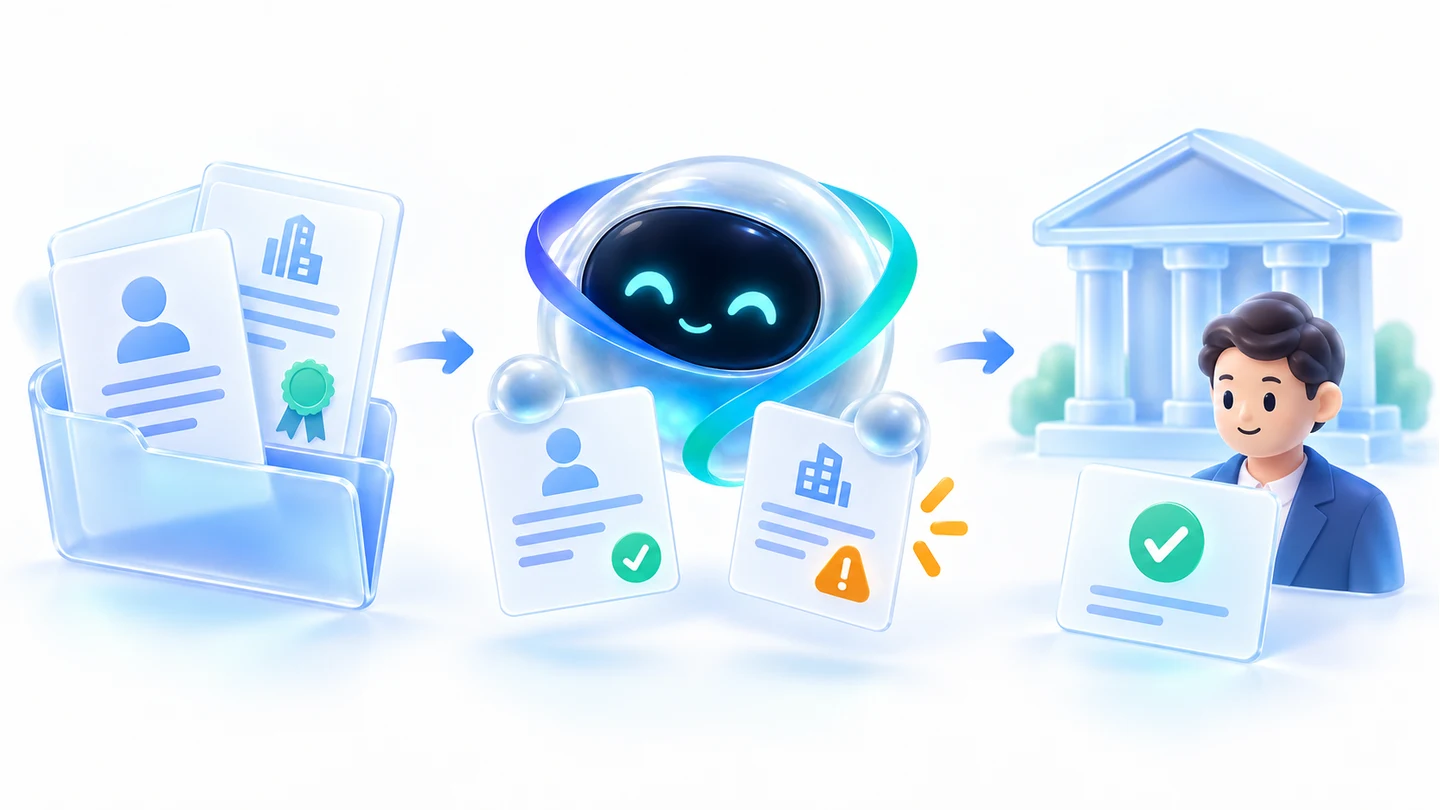
The application in our opening example contains a company registration, ownership declaration, identity documents and an account form. The declared owner name differs from a registry record. A later email includes an updated document. The bottleneck is reconciling the evidence and deciding which checks must run again.
From an application pack to a reviewable customer file
- Open and classify. Create a case, identify the requested product and jurisdiction, classify the documents and apply the approved completeness checklist.
- Extract and reconcile. Compare legal names, identifiers, signatories and ownership evidence. Keep links to the pages supporting each value.
- Invoke approved checks. Submit permitted fields to identity, registry and screening services. Preserve their responses and distinguish a possible match from a confirmed finding.
- Resolve the exception. Draft a precise request about the conflicting ownership information. Route it according to the bank's communication policy.
- Prepare and approve. Give the authorized reviewer a completeness summary, unresolved findings and the applicable policy. Hold account activation until required approvals are satisfied.
- Execute and verify. Send approved data to the customer and account systems, verify the result and retain the evidence supporting the action.
Human authority Resolve material discrepancies, decide escalated risk and authorize the permitted outcome.
Business measures Time to a complete file, repeat document requests, rework, exception age and cost per completed onboarding.
When the updated document arrives, the orchestrator versions the case, identifies affected findings and reruns dependent checks. It should not discard valid unrelated work, but it must not reuse an approval tied to evidence that has materially changed.
The distinction between extraction and verification matters here. Reading a passport or registration document does not establish authenticity, identity assurance or completion of customer due diligence (CDD). FATF’s digital identity guidance addresses how to assess whether digital identity arrangements are suitable for CDD; it does not make a language model a substitute for that assessment. Source: FATF Guidance on Digital Identity.
This pattern can extend to periodic KYC reviews, lending document preparation and trade-finance file checks. The reusable capability is evidence assembly with controlled escalation. Each new product still requires its own policy, authority and evaluation. For the underlying document problem, see KYC automation in GCC banking and document automation for financial services.
Insurance: connect onboarding, underwriting and claims evidence

Insurance introduces an additional problem: a document can be genuine and relevant but apply to the wrong coverage period. An agent reviewing a claim needs the policy schedule, wording and endorsements that governed the event. The latest file in the repository may not be the applicable contract.
For new policyholder onboarding, an agent can assemble proposal forms, identify missing declarations, compare the application with supporting evidence and prepare underwriting questions. It should preserve the distinction between information collection, underwriting judgment and authority to issue cover.
A commercial claim with conflicting dates
A business reports damage and submits photographs, a repair estimate and an incident report. The reported event date differs between two documents, and a policy endorsement took effect between those dates.
- Assemble the claim. Link the notification, policy record and supporting documents to the correct policyholder and insured asset.
- Build the chronology. Extract event dates and amounts, locate the relevant clauses and identify the competing coverage interpretations.
- Explain the gap. Prepare a cited summary of the date conflict and the evidence needed to resolve it. Do not select the convenient date silently.
- Route the decision. Send the package to the authorized claims handler. Coverage decisions, adverse findings and payments follow delegated authority and review rules.
Human authority Resolve disputed facts, interpret material ambiguity and authorize settlement or referral.
Business measures Handling time, repeated evidence requests, reopened claims, reviewer corrections and complaints.
The same case context should follow a file from onboarding into servicing and claims, with access limited to the role and purpose. A claim summary must not erase an exclusion or disclose unrelated personal information simply because it appeared in an attachment.
EIOPA’s August 2025 opinion frames AI governance in insurance through a proportionate, risk-based approach to existing sector requirements. It is a useful supervisory reference for designing controls around the consequence of a use case, rather than treating every AI application as equivalent. Source: EIOPA opinion on AI governance and risk management.
Government: prepare a complete, explainable service case

Public-sector workflows often bring together application forms, supporting certificates, correspondence and records from multiple departments. An applicant experiences them as one service even when the evidence crosses several systems. An agent can help organize that evidence and make the next step clearer.
Consider a business applying for an operating permit. An old checklist remains in a shared folder, a certificate is missing, and one document uses a previous trading name. The useful contribution is to find the current requirements and prepare a coherent case for an authorized officer.
A permit application ready for an officer's decision
- Establish the service context. Identify the application type, competent authority and requirements applicable on the relevant date.
- Check the submission. Classify forms and certificates, compare names and identifiers, and distinguish missing evidence from an adverse finding.
- Prepare the next step. Draft an accessible request for the missing certificate with the exact requirement and approved submission channel.
- Support the officer. Present the complete file, source citations and outstanding issues. Record the authorized decision and explanation.
Human authority Exercise statutory discretion, resolve exceptional cases and handle challenges.
Service measures Complete-submission rate, waiting time, repeat contacts, correction rate and accessibility outcomes.
The workflow should preserve a route to a person, accommodate applicants whose evidence does not fit the standard pattern, and record the basis of a decision so it can be challenged. Cross-agency access needs explicit authority; a shared case identifier is not permission to retrieve every record about an applicant.
The UK Government AI Playbook includes meaningful human control among its core principles. It provides a useful design reference for responsibility, oversight and service delivery, while an actual implementation must follow its own jurisdiction’s law and administrative process. Source: AI Playbook for the UK Government.
Human approval must be part of execution
A reviewer cannot exercise meaningful judgment with only a green indicator and an “Approve” button. The workflow must show what will happen, which evidence supports it, what remains uncertain and whether the reviewer has the authority to authorize it.
Make the decision inspectable
Approval attaches to a specific action and a specific version of the evidence.
- Proposed action
- The exact update, recipient, amount or case transition.
- Supporting evidence
- Source documents, page references and validation results.
- Applicable policy
- The requirement, version and scope used in the assessment.
- Open questions
- Conflicts, missing evidence and alternative interpretations.
- Reviewer choices
- Approve, reject, correct, request evidence or escalate.
- Execution receipt
- Who approved what, when it ran and whether it succeeded.
Use risk and reversibility to decide where the gate sits. A bounded classification task may proceed automatically after validation. A draft customer message may need review before sending. An account activation, disputed claim outcome or permit decision requires the authority defined for that process. There is no universal model confidence score that grants permission to act.
Human review also needs operational capacity. Define review queues, service levels and escalation paths. Sample apparently successful cases as well as exceptions to detect failures that were never flagged. Monitor whether reviewers routinely approve without checking, and redesign the evidence presentation if the queue encourages rubber-stamping.
If material evidence changes after approval, pause the dependent action and obtain a fresh decision. If an execution fails, preserve the approval and transaction history while determining whether it is safe to retry. An approval is neither a permanent license nor proof that the downstream action succeeded.
How to build the business case and prove value
Start with one bounded process where the evidence is accessible, the result can be checked and someone owns the outcome. “Reduce avoidable document handling in business-account onboarding” is an assessable objective. “Deploy a digital workforce” does not specify what success means.
Establish a baseline before introducing agents. Measure staff touch time separately from elapsed time: a case can require ten minutes of work but spend days waiting for missing evidence. An agent that accelerates reading will not remove a delay caused by an unclear customer request or an understaffed approval queue.
| Measure | How to use it |
|---|---|
| Cost per completed case | Include human review, rework, model and tool usage, integration and ongoing control costs. |
| First-pass completeness | Track cases ready for the next stage without another evidence request. |
| Decision-support quality | Measure correct findings, missed issues, unsupported claims and source coverage. |
| Control effectiveness | Test prohibited actions, access leakage, approval bypass and duplicate writes. |
| Human and service outcomes | Track reviewer corrections, queue age, complaints and the experience of affected users. |
A simple business-case model is net annual benefit = realized capacity or cost benefit + measured rework reduction - implementation and annual operating costs. Count revenue or conversion gains only when they are measured and attributable. Released staff time is capacity; it becomes a cash saving only if staffing or spending actually changes. Avoid counting the same reduction in both handling time and rework.
A practical sequence from pilot to controlled operation
- Define the boundary. Select one process, owner, outcome and set of permitted actions. Document conditions that must stop execution.
- Prepare representative evidence. Include ordinary cases, poor scans, duplicates, multilingual documents, name conflicts, missing pages and restricted records.
- Evaluate without executing. Compare proposed outputs against expert-reviewed cases, then run in shadow mode alongside the existing process.
- Pilot with explicit authority. Start with limited volume and an effective human gate. Test timeouts, changed evidence, malicious document instructions and attempted approval bypass.
- Expand only after acceptance. Set acceptance criteria before the pilot, segment results by case type and consequence, and give the operating team a stop and recovery procedure.
Do not judge quality on a blended accuracy percentage alone. Correctly routing many routine documents can conceal a missed ownership discrepancy. Evaluate the errors that change the business outcome, including false negatives, and repeat evaluation when policies, models, tools or source populations change.
Connecting information, orchestration and people with Contellect
The architecture connects three disciplines already central to Contellect’s content operations approach: preparing usable information, governing its lifecycle and moving work through controlled processes. For organizations adopting agents, these disciplines define the foundation on which model reasoning can operate.
Map intelligent document processing to evidence preparation, content intelligence to retrieval and analysis, and process automation to routing and approvals. The Contellect platform orchestrator and enterprise integration are relevant areas to evaluate when defining cross-system execution. Specific agent responsibilities, connectors and approval rules should be established during solution design and demonstrated against representative cases.
The opportunity is concrete: less time spent finding, copying and reconciling information; better evidence at the point of decision; and a process that remains understandable when something goes wrong. That outcome depends on knowing what the agent may do, what information it can trust and who takes responsibility for the next step.
Further reading
Continue with AI data readiness, enterprise document workflow automation and document digitization and the lifecycle gap to connect the agent layer with the information and operating controls beneath it.