AI Data Readiness: Enterprise Guide
Assess AI data readiness, fix unstructured content, and build a governed foundation for reliable enterprise AI at scale.
Enterprise AI rarely fails because a model cannot produce fluent language. It fails because the information behind the model is incomplete, duplicated, inaccessible, poorly classified, overexposed, or impossible to verify. A chatbot can sound confident while using an obsolete policy. An automation can move faster while acting on the wrong version of a customer file. A retrieval system can find more content while exposing material the user was never authorized to see.
That is why AI data readiness is now an operating requirement, not a preliminary IT checklist. It determines whether an AI service can find the right evidence, understand its context, respect access controls, support a business decision, and leave an audit trail that people can review.

Why AI data readiness has become urgent
Organizations have spent years accumulating documents across file shares, email, collaboration platforms, line-of-business systems, imaging archives, document management systems, and physical records. Much of that information is useful. Much of it is also missing metadata, duplicated, trapped in old formats, governed by inherited permissions, or detached from the business event that gives it meaning.
Generative AI makes this condition visible. Traditional search can return a list of documents and leave the user to judge them. An AI assistant synthesizes an answer, which increases the value of good context and the cost of bad context. When the source estate is weak, the AI can retrieve irrelevant material, combine conflicting versions, omit critical evidence, or answer beyond the user’s authority.
The practical question is therefore not, “Do we have enough data?” Most enterprises have more than enough. The better questions are:
- Can the system identify the authoritative source?
- Can it distinguish a final record from a draft or duplicate?
- Does it understand document type, owner, subject, date, case, and retention state?
- Are permissions enforced on the individual content item and its extracted data?
- Can a reviewer trace an answer or action back to evidence?
- Can low-confidence cases be stopped and routed to a person?
- Can the information remain governed after AI begins using it?
AI data readiness, data readiness, and AI readiness
The terms overlap, but they are not interchangeable.
Know which readiness problem you are solving
A credible program connects technical quality, information control, and operational responsibility.
Data readiness
Is the required data complete, accurate, consistent, timely, and technically available?
Primary lens: quality and accessAI data readiness
Can AI use the information with enough context, permission control, provenance, and validation for the intended task?
Primary lens: trustworthy inputsOrganizational AI readiness
Can the enterprise govern, operate, monitor, fund, and improve AI safely after deployment?
Primary lens: sustainable adoptionAn organization can be strong in one area and weak in another. A modern data platform does not automatically fix permissions on legacy documents. A well-governed archive does not automatically provide the metadata an AI search experience needs. A successful pilot does not automatically create the ownership, monitoring, and exception capacity required at scale.
The five pillars of AI-ready information
The following scorecard turns a broad ambition into an assessable operating model. Evaluate each pillar against a specific use case, not against an abstract vision of the whole enterprise.
Five pillars determine whether AI can be trusted
Weakness in one pillar can undermine the rest. Score evidence, not platform features.
Outcome and ownership
The use case has a measurable service or business outcome, accountable owner, approved authority, affected users, and defined failure conditions.
Evidence: baseline, KPI, owner, decision rightsContent quality and context
Documents are readable, deduplicated where necessary, associated with useful metadata, and linked to the customer, case, transaction, asset, or policy they describe.
Evidence: sampled quality profile and metadata coverageGovernance and security
Authoritative versions, permissions, privacy constraints, legal holds, retention rules, residency, and disposition obligations are known and enforceable.
Evidence: control mapping and access testsLifecycle and integration
Information can move through capture, validation, review, approval, records control, and downstream systems without creating an ungoverned copy.
Evidence: process map, interfaces, exception pathsAI activation and assurance
Retrieval, extraction, summarization, and agent actions are grounded in approved sources. Confidence, citations, human review, monitoring, and rollback are designed into the service.
Evidence: evaluation set, thresholds, logs, operating controlsA simple rating method
Use four evidence-based ratings for each pillar:
- Uncontrolled: ownership or source conditions are unknown.
- Mapped: the estate and risks are understood, but controls remain manual or inconsistent.
- Ready: the selected use case meets documented thresholds and can enter a controlled pilot.
- Scaled: reusable controls, monitoring, and service ownership support repeatable expansion.
An average score can hide a critical weakness. Treat security, legal authority, authoritative-source identification, and unacceptable failure conditions as gates. A strong metadata score should never compensate for permission leakage.
Why unstructured content is the hidden readiness gap
Many data programs concentrate on databases, warehouses, and analytics tables. Yet critical business evidence often lives in contracts, account files, correspondence, forms, statements, identity documents, reports, images, PDFs, and email attachments. This content is not unimportant because it is unstructured. It is often the source material behind the structured fields.
To prepare it for AI, an enterprise may need to:
- Inventory repositories and physical archives.
- Detect file types, corrupted objects, password protection, and unreadable scans.
- Separate compound files and classify documents at page or document level.
- Extract entities, dates, amounts, identifiers, clauses, and relationships.
- Validate extraction against business rules and reference systems.
- Apply metadata, ownership, security, and retention information.
- Reconcile duplicates, versions, and authoritative records.
- Route exceptions to trained reviewers.
This is where intelligent document processing becomes foundational. IDP turns content into governed, machine-usable information by combining capture, classification, extraction, validation, and workflow. It does not remove the need for governance or human judgment. It gives those controls a practical point of execution.
From archive to AI: Contellect’s end-to-end service
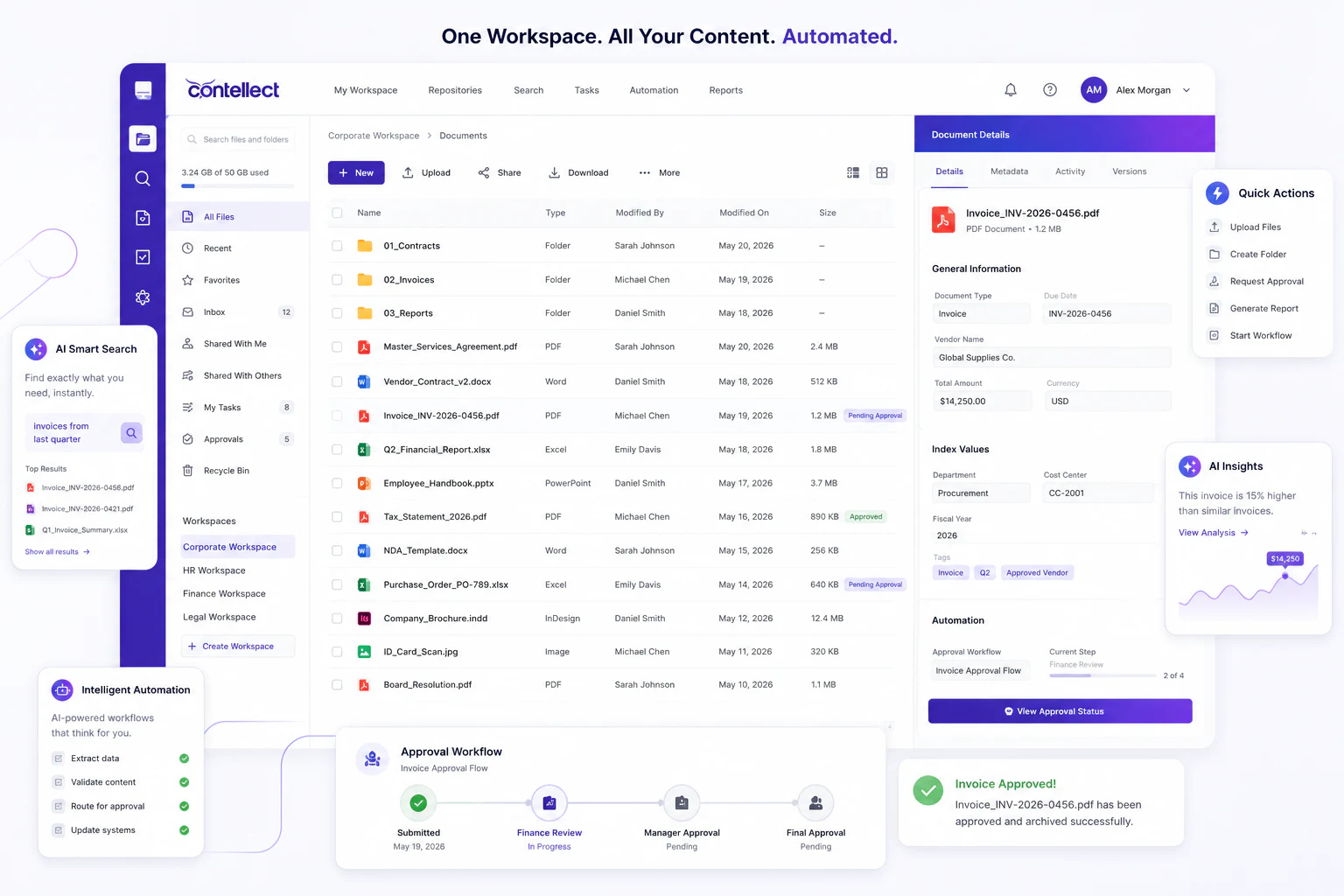
Buying an AI model does not prepare an information estate. The work crosses records, operations, security, architecture, data, process design, and change management. Contellect brings those disciplines together as one outcome-led service, supported by Contellect One and its AI-powered document capabilities.
One service from discovery to governed AI operations
Each stage produces evidence for the next, so the program can move quickly without losing control.
- 01
Discover
Define the business outcome, inventory sources, sample content, map obligations, and establish a measurable baseline.
- 02
Remediate
Identify duplicates, obsolete content, quality defects, access risks, unsupported formats, and missing ownership.
- 03
Digitize and capture
Ingest paper and digital archives through controlled, traceable pipelines with image improvement and completeness checks.
- 04
Classify and enrich
Use AI-powered IDP to separate documents, extract data, apply metadata, establish relationships, and route exceptions.
- 05
Govern and secure
Map permissions, retention, privacy, versions, provenance, and disposition to content and extracted information.
- 06
Integrate and migrate
Connect systems of record, move validated information in controlled waves, reconcile results, and preserve continuity.
- 07
Activate and improve
Deploy search, retrieval, extraction, summarization, or agent workflows with evaluation, monitoring, and human oversight.
This model can support a new AI assistant, a legacy repository migration, an enterprise search program, a regulated content process, or a broader intelligent content structuring initiative. The sequence is adapted to the risk and outcome. Not every program needs every repository on day one.
Proof at enterprise scale: 50 million pages in three months
Readiness must work at production volume
Contellect delivered a large-scale financial-sector content transformation covering 50 million pages in three months. The significance is not volume alone. Programs at this scale require coordinated ingestion, document processing, quality control, exception handling, metadata, security, migration, reconciliation, and operational reporting.
This experience shapes how Contellect designs AI data readiness: sampling before scale, explicit acceptance rules, automation with human review, traceable batches, capacity planning, and evidence that the target system received what the source estate contained.
The 50 million-page engagement is a proof point for delivery scale, not a universal timeline promise. Actual throughput depends on document condition, source access, classification complexity, extraction scope, languages, validation rules, infrastructure, security constraints, and exception rates. A responsible plan measures these factors during discovery and pilot work before setting production commitments.
Common readiness risks and the controls that answer them
Turn vague AI concerns into testable controls
Conflicting versions
AI grounds an answer in a superseded policy or draft.
ControlVersion status, effective dates, authoritative-source rules, and retrieval filters.
Permission leakage
Inherited repository access exposes restricted content or extracted fields.
ControlContent-level security mapping, identity-aware retrieval, and adversarial access tests.
Missing context
A document is readable but detached from its case, customer, transaction, or record class.
ControlMetadata enrichment, entity resolution, relationships, and required-field thresholds.
Silent extraction errors
Incorrect values enter a downstream process without review.
ControlField-level confidence, validation rules, reference checks, and human exception queues.
Untraceable answers
Users cannot determine which evidence supported a response.
ControlCitations, source snapshots, query logs, model and prompt records, and review history.
Unmanaged retention
AI indexes information that should be held, disposed, or restricted.
ControlRetention-aware indexing, legal-hold integration, disposition controls, and audit evidence.
Move from a defined outcome to controlled scale
Six decision gates keep information quality, governance, and business value connected throughout the program.
-
01
Discover Select the outcome and authority
Choose a measurable process outcome. Name the owner, authority, users, information classes, baseline, and unacceptable failure conditions.
Gate: approved outcome and accountability -
02
Discover Profile representative information
Sample real content, including restricted files, handwriting, unusual formats, poor scans, duplicates, multiple languages, and common exceptions.
Gate: measured quality and variability -
03
Prepare Design the governed target
Define taxonomy, metadata, relationships, permissions, retention, authoritative sources, integration boundaries, review roles, and evidence.
Gate: target controls signed off -
04
Prove Build a bounded proof of value
Test classification, extraction, search, citations, access, workflow, exceptions, and audit history against published acceptance thresholds.
Gate: evidence meets thresholds -
05
Scale Expand in controlled waves
Move by repository, record class, business unit, geography, or process. Reconcile content, metadata, permissions, and exceptions after every wave.
Gate: business acceptance by wave -
06
Scale Operate and improve
Monitor drift, quality, relevance, access, exceptions, experience, latency, cost, and business KPIs under formal ownership and change control.
Gate: stable service with active monitoring
Metrics that prove readiness and value
Measure information fitness, control effectiveness, AI performance, and business impact together. A fast service built on weak evidence is not ready.
Information fitness
- Readable-page and supported-format rate
- Required metadata completeness
- Duplicate and superseded-version rate
AI quality
- Classification accuracy by document type
- Field precision, recall, and confidence
- Retrieval relevance and citation coverage
Control assurance
- Permission-test pass rate
- Audit-evidence completeness
- Insufficient-evidence and escalation rate
Operational value
- Throughput and cost per page or case
- Process completion time
- Exception volume and reviewer effort
- Adoption, correction, and user feedback
Context changes the meaning of accuracy. A 98 percent result can be excellent for low-risk routing and unacceptable for a critical account identifier. Segment every measure by document type, source, language, quality band, consequence, and business outcome.
How financial institutions can apply the model
Financial organizations hold high volumes of sensitive, document-heavy information with long retention periods and strict access requirements. Strong starting points include customer onboarding, KYC file completeness, commercial lending, mortgage archives, trade-finance documents, complaints, legal correspondence, policy and procedure search, and records remediation.
For example, an onboarding readiness program can connect identity files, forms, corporate records, approvals, screening evidence, and correspondence to one governed customer context. IDP can classify and extract the documents. Business rules can validate required evidence. Human reviewers can resolve exceptions. Contellect One can make the approved content searchable and route work while preserving permissions and audit history.
The goal is not to let AI make every decision. It is to reduce avoidable document handling, give authorized staff better evidence, and reserve human attention for ambiguity, risk, and judgment.
What to ask an AI data readiness partner
Before selecting a platform or service partner, ask:
- How will you profile the real content population before committing to scope and throughput?
- How do you distinguish authoritative, obsolete, duplicate, and incomplete information?
- How are document-level permissions preserved through extraction, search, and AI use?
- Which quality thresholds can be configured by document type and field consequence?
- How are exceptions reviewed, corrected, and fed back into operations?
- What evidence proves that migration or processing is complete?
- How do retention, legal hold, privacy, and disposition affect AI indexing?
- How are citations, prompts, model versions, and agent actions logged?
- What happens when a source system, connector, or model is unavailable?
- Which business KPIs will prove that the program created value?
Build reliable AI from reliable information
AI readiness is not achieved by moving every document into one location or by connecting a language model to every repository. It comes from aligning information quality, context, governance, permissions, lifecycle controls, integration, and operational accountability around a real outcome.
Contellect combines advisory work, large-scale content services, AI-powered intelligent document processing, information governance, migration, integration, workflow, and Contellect One activation in one delivery model. That end-to-end approach helps enterprises move from scattered archives to usable evidence, and from isolated AI experiments to reliable production services.
If your organization is preparing document-heavy information for enterprise AI, talk with Contellect about a readiness assessment and a phased proof of value.