Intelligent document processing (IDP) is the use of AI to convert unstructured documents into structured, validated data that downstream systems can act on.
The term describes a pipeline rather than a single technique. A document arrives in some human-readable form, such as a scan, a photograph, a PDF or an email attachment, and leaves as records in a database, fields in a case management system, or a message on a queue. Everything between those two points is IDP.
The stages of the pipeline
A typical implementation runs six stages: ingest, read, classify, extract, validate and route.
Ingest collects documents from the channels an organization actually uses. In practice this is rarely a single source. Scanned post, shared mailboxes, upload portals, SFTP drops from partners and exports from legacy systems all tend to appear in the same project.
Read converts the document image into machine-readable text and layout. This is where optical character recognition sits, along with page segmentation, table detection and reading-order analysis.
Classify decides what the document is. Document classification determines the type, and often the business context, record category and sensitivity, because those decisions drive everything after them.
Extract pulls the specific values the process needs. Document data extraction covers header fields, line items, tables, clauses, dates, parties and signatures.
Validate checks the extracted data against rules, reference data and internal consistency. An invoice total that does not equal the sum of its lines is caught here, as is a supplier that does not exist in the vendor master.
Route hands the result to whatever comes next: an approval, an exception queue, a system of record, or a human reviewer.
How IDP differs from OCR
This is the distinction most often collapsed in vendor material, and it matters. OCR answers the question “what characters are on this page”. IDP answers “what is this document, what does it mean, and is it correct”.
OCR produces text. IDP produces structured data with a known schema, a confidence value per field, a validation outcome and an audit trail. A system that stops at OCR has converted an image into a wall of characters, which is easier to search and no easier to process automatically.
Practically, the difference is everything OCR does not do: classification, field-level extraction, validation against business rules, confidence scoring with thresholds, exception handling and workflow integration.
How IDP relates to RPA
Robotic process automation and IDP are complementary rather than competing. RPA is good at driving systems that have no usable API, by operating their interfaces the way a person would. It is poor at interpreting an unstructured document, because there is no deterministic sequence of clicks that reads a contract.
The common pattern is IDP producing structured data and RPA or a workflow engine acting on it. Where teams get into difficulty is using RPA alone against documents, typically with brittle template matching, and then discovering that a supplier changing their invoice layout breaks the automation silently.
What commonly goes wrong
Accuracy is measured on the wrong thing. A field-level accuracy figure averaged across all fields hides the fields that matter. Getting a document reference right 99 percent of the time and a payment amount right 90 percent of the time is not a 94 percent system, it is a system that will pay the wrong amount.
Confidence thresholds are set globally. A threshold that works for a printed invoice is wrong for a handwritten form. Thresholds belong per document type and often per field.
Exception handling is designed last. The straight-through processing rate is never 100 percent, so the reviewer experience determines whether the system saves time overall. A queue that is slower to work than the original manual process eliminates the benefit.
Training data does not match production. Models built on clean samples degrade on the photographed, skewed, partly redacted documents that arrive in reality.
Where it is used
IDP is applied wherever document volume is high and the downstream process is rule-governed: accounts payable, claims handling, customer onboarding and know-your-customer checks, loan origination, trade documentation, and records digitization programs. The common factor is not industry but the combination of unstructured input and a process that must be auditable.
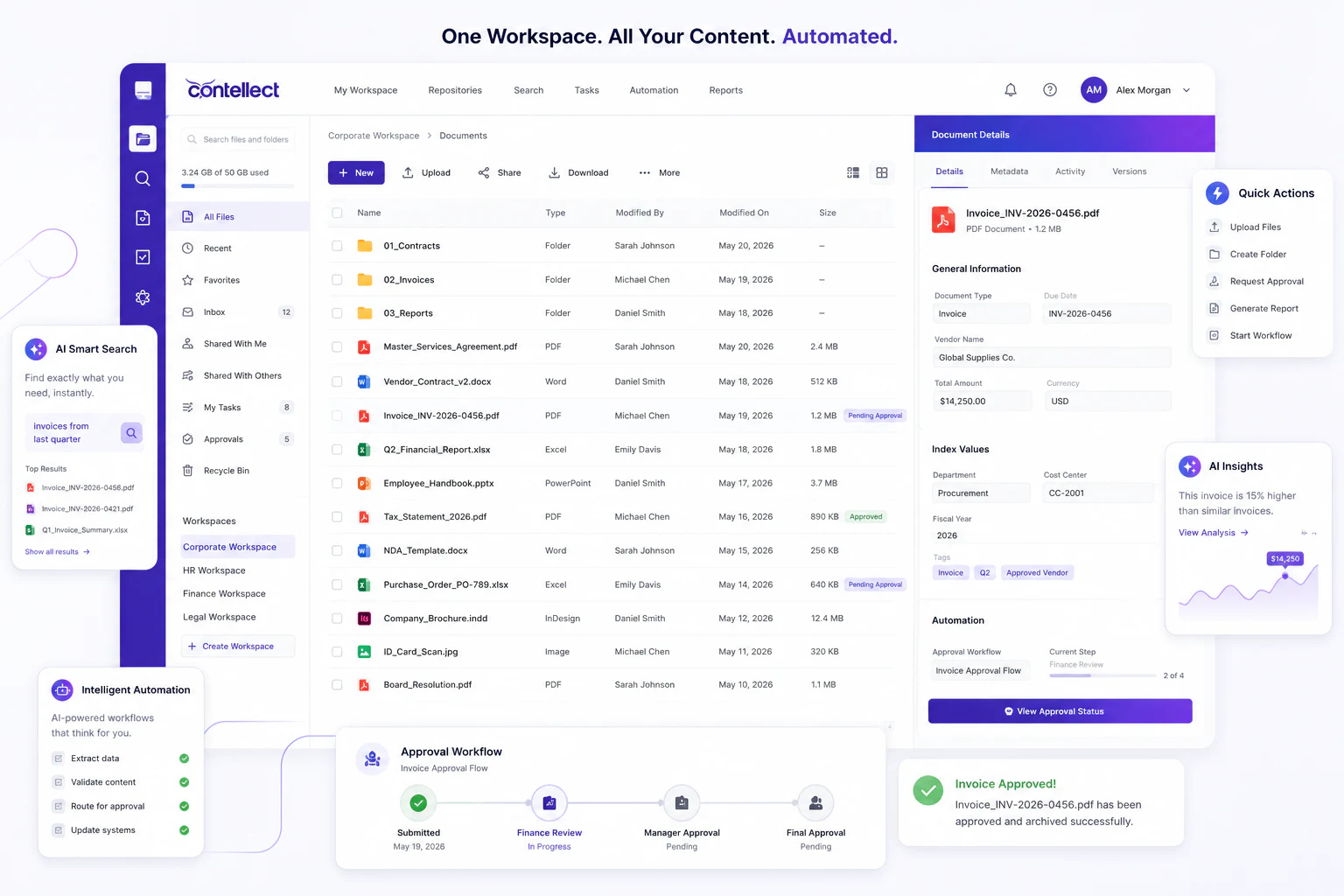
Contellect One implements this pipeline in intelligent document processing, across the six stages described above.