Government Information Management with AI
A practical roadmap for government agencies to modernize information management with secure AI, automation, governance, and measurable service outcomes.

Key takeaways
- Government AI modernization should begin with a service or operational problem, not with a model or tool.
- Intelligent automation can reduce document backlogs while preserving human authority over exceptions and consequential decisions.
- Compliance, security, accessibility, records obligations, and auditability must be designed into the workflow from the start.
- Agencies can modernize around existing systems through phased integration instead of attempting a high-risk replacement program.
- Uncertainty should be managed with bounded pilots, decision gates, confidence thresholds, rollback plans, and measurable evidence.
Direct answer: Modern government information management uses AI and automation to capture, classify, secure, retrieve, route, and govern agency information across its lifecycle. The objective is not simply faster processing. It is faster, more reliable public service with traceable decisions, protected information, defensible records, and clear human accountability.
Government agencies manage a uniquely demanding information environment. A single service can involve forms, correspondence, evidence, identity documents, case notes, email, scanned records, maps, reports, approvals, and data from several line-of-business systems. That information may be subject to disclosure rules, retention schedules, privacy obligations, security controls, accessibility standards, legal holds, and public expectations for timely service.
The result is a difficult operating tension. Agencies must process more information and respond faster, often with limited staff and aging technology, while maintaining a higher standard of accountability than most commercial organizations.
AI and automation can help, but only when they are introduced as part of an information management strategy. Automating a weak process can move errors faster. Connecting an AI assistant to an unmanaged repository can surface obsolete or restricted information. The modernization opportunity comes from combining intelligent processing with governance, security, integration, and measurable service design.
What is modern government information management?
Modern government information management is the coordinated control of agency information from receipt or creation through active use, retention, preservation, disclosure, and final disposition. It connects four disciplines that are often managed separately:
- Content operations: capture, classification, indexing, search, collaboration, workflow, and case assembly.
- Information governance: ownership, authority, quality, retention, legal hold, disclosure, and disposition.
- Security and privacy: classification, least-privilege access, encryption, monitoring, data minimization, and incident response.
- Service delivery: processing time, employee workload, citizen experience, accessibility, transparency, and outcome quality.
Modernization succeeds when these disciplines reinforce one another. A document should not become easier to process but harder to audit. Faster search should not bypass permissions. Lower storage cost should not make a public record impossible to retrieve. AI-generated assistance should not hide the source used to support an answer.
Why government information ecosystems become difficult to manage
Information arrives in too many forms
Agencies receive structured data and unstructured content through portals, email, paper, shared drives, mobile devices, partner systems, and in-person service channels. Staff may need to inspect, rename, classify, enter, route, and validate the same information manually before work can begin.
Systems reflect programs, not complete journeys
Departmental applications often support one stage of a service. The complete case may span a content repository, records platform, email system, finance application, identity service, and a specialist database. Employees become the integration layer, moving information between screens and reconstructing context by hand.
Backlogs hide risk as well as delay
A backlog is not only a service-level problem. It may contain an unanswered citizen request, an expiring permit, a missed retention trigger, an incomplete inspection, a disclosure deadline, or a document waiting for security review. Prioritization requires context, not just arrival order.
Legacy systems preserve critical dependencies
Older platforms can hold authoritative records, embedded rules, integrations, and operational knowledge. Replacing them all at once creates cost and continuity risk. Leaving them untouched creates growing security, support, and accessibility constraints. Agencies need a controlled path between these extremes.
AI-powered efficiency for document-intensive government work
AI-powered efficiency is most valuable where employees spend time interpreting and moving information before they can apply professional judgment. Intelligent document processing can turn incoming content into structured, validated work items through a sequence such as:
- capture a document or message from an approved channel;
- identify its document and service type;
- extract relevant fields and entities;
- detect missing pages, signatures, attachments, or required evidence;
- check extracted information against business rules and trusted systems;
- identify sensitive or restricted content;
- route the case to the correct queue with a priority and due date;
- send low-confidence or high-impact exceptions to an authorized reviewer;
- write the final document, metadata, decisions, and audit events to the system of record.
This approach does not remove people from public administration. It moves their attention away from repetitive preparation and toward exceptions, judgment, communication, and accountability.
High-value automation candidates
| Process | Common information challenge | Useful AI and automation role |
|---|---|---|
| Correspondence intake | Messages arrive across channels and require manual distribution | Classify intent, detect urgency, link prior correspondence, and route to the responsible unit |
| Permits and licenses | Incomplete applications create repeated follow-up | Extract fields, verify required evidence, flag omissions, and assemble the review file |
| Public records requests | Responsive records sit across multiple repositories | Support governed search, deduplication, review queues, and redaction workflows |
| Grants administration | Applications contain long narratives and supporting evidence | Check completeness, summarize sections, compare required criteria, and route exceptions |
| Benefits and claims | High volumes create backlogs and inconsistent triage | Classify submissions, validate evidence, prioritize time-sensitive cases, and preserve human decisions |
| Inspection and enforcement | Photos, reports, notices, and history must be connected | Assemble case context, detect missing artifacts, track deadlines, and generate controlled notices |
Choose processes where inputs are understood, ownership is clear, performance can be measured, and exceptions can be safely escalated. Avoid beginning with ambiguous decisions that lack stable policy or reliable historical evidence.
Compliance without compromise
Compliance and efficiency are not opposing objectives. A well-designed digital process can make compliance more consistent by applying required controls automatically and recording evidence as work happens.
The key is to translate obligations into operational rules. Instead of relying on employees to remember every requirement, the workflow can enforce:
- required metadata and document types before a case advances;
- retention classification at creation or capture;
- legal-hold checks before disposition;
- separation of duties for approvals and releases;
- version status and authority for policies and decisions;
- accessibility checks for public-facing outputs;
- controlled redaction and disclosure review;
- complete audit events for access, changes, approvals, exports, and deletion;
- documented exceptions when a standard rule cannot be applied.
Records management establishes how long official information must be retained and when it may be destroyed. Information governance defines the wider accountability for value, risk, ownership, security, and acceptable use. AI workflows should consume these controls rather than operate beside them.
Make every consequential output traceable
An AI summary, classification, recommendation, or search answer should carry enough evidence for a reviewer to understand how it was produced. Depending on the use case, that can include:
- the source document and stable identifier;
- the exact passages or fields used;
- model or rule version;
- confidence score and validation result;
- reviewer identity and decision;
- time, permissions, and policy state;
- corrections or overrides made after generation.
Traceability supports audit, appeals, quality improvement, records obligations, and public trust. It also helps agencies distinguish a system failure from a source-information problem.
A security-first approach across the information lifecycle
Security cannot be added after an AI pilot has already indexed agency content. It begins with deciding what information the service is permitted to use, for which purpose, in which environment, and on whose authority.
Before capture
- approve channels, file types, and integration endpoints;
- minimize information collected to what the service requires;
- define prohibited content and high-risk categories;
- document data residency and processing boundaries.
During processing
- encrypt information in transit and at rest;
- apply malware and file-integrity checks;
- classify sensitivity and record type early;
- isolate workloads and service accounts;
- prevent unapproved model training or data reuse;
- log access, extraction, prompts, outputs, and workflow actions.
During retrieval and AI use
- enforce source-level permissions at query time;
- filter by purpose, jurisdiction, authority, and lifecycle status;
- prevent obsolete or superseded records from outranking current sources;
- provide citations and clear uncertainty indicators;
- restrict downloads, sharing, and bulk extraction where needed.
At retention and disposition
- apply retention schedules and legal holds to source content and derived outputs;
- remove expired information from search indexes, caches, and downstream stores;
- record disposition approval and execution evidence;
- test that deletion or restriction propagates across integrated services.
Zero-trust principles are especially useful in hybrid environments: verify the identity, device, service, permission, and policy context for every access rather than trusting location alone.
A phased government AI modernization roadmap
Treat modernization as a sequence of evidence-based decisions. Each phase should produce a clear deliverable and a checkpoint before the agency commits more systems, information, or public services to the program.
Start with purpose
Define the service outcome
Choose a measurable public or operational result, such as reducing permit backlog age, shortening correspondence response time, improving first-submission completeness, or accelerating case-file assembly.
Understand the work
Map information and decisions
Identify every input, repository, system of record, handoff, exception, output, retention trigger, decision, and user role. Separate deterministic checks from decisions that require trained judgment.
Establish trust
Prepare a governed information foundation
Improve classification, metadata, document quality, permissions, version status, retention mapping, and provenance. Connect only approved sources and identify the authoritative policy and complete case record.
Intelligent data captureDocument classificationEnterprise search
Prove the value
Run a bounded proof of value
Use a representative sample, controlled user group, and clear thresholds. Keep the scope narrow enough to inspect errors and broad enough to include real exceptions.
- Accuracy and false-result rates
- Performance across languages and channels
- Exception volume and reviewer effort
- Permissions, audit evidence, and security
- Citizen experience and cost per case
Connect safely
Integrate with existing government IT
Preserve the system of record and introduce automation through documented APIs, events, queues, or controlled connectors. Use stable identifiers and idempotent transactions so retries never create duplicate cases or actions.
Expand with control
Scale through reusable controls
Turn proven patterns into shared capture connectors, models, security controls, audit schemas, human-review components, dashboards, retention integrations, accessibility checks, and deployment templates.
Navigating uncertainty without losing momentum
Government modernization operates under policy change, budget cycles, procurement constraints, evolving technology, legacy dependencies, public scrutiny, and incomplete information. Waiting for all uncertainty to disappear guarantees delay. Ignoring it creates avoidable risk.
The practical response is to make uncertainty visible and bounded.
Maintain an assumption and evidence register
Record the assumptions that support the business case, design, data quality, workload, integration, accuracy, adoption, and cost estimates. Assign an owner and a date by which each assumption must be tested. An assumption that remains untested should not quietly become a fact.
Use decision gates
Define the evidence required to move from discovery to pilot, pilot to limited production, and limited production to wider deployment. A gate can require minimum accuracy, zero unresolved critical-security findings, acceptable exception workload, complete audit logging, and confirmed records treatment.
Design safe failure modes
When confidence is low, information is missing, or a dependency fails, the workflow should stop, queue, or fall back to an established manual path. It should not invent a value, skip a control, or silently discard work.
Keep rollback and exit options
Use exportable records, documented interfaces, reversible configuration, model and prompt versioning, and clear ownership of generated artifacts. Agencies should be able to suspend the AI component while preserving service continuity and the official record.
Monitor leading indicators
Backlog size is a lagging indicator. Earlier warning signals include rising exception rates, falling confidence, longer reviewer queues, increased overrides, permission mismatches, inaccessible outputs, source drift, and integration retries.
How to measure transformation
| Objective | Example measures |
|---|---|
| Service | Citizen wait time, completion time, first-contact resolution, application completeness |
| Operations | Backlog age, processing time, cost per case, manual touches, exception workload |
| Quality | Extraction accuracy, classification accuracy, reviewer corrections, rework rate |
| Compliance | Policy coverage, overdue retention actions, audit findings, disclosure timeliness |
| Security | Excessive-access findings, blocked events, unresolved vulnerabilities, incident rate |
| Adoption | Active users, workflow completion, training completion, employee satisfaction |
| Resilience | Availability, recovery time, failed transactions, successful fallback execution |
Publish measures with context. A faster average can hide worse outcomes for complex cases, minority languages, accessibility needs, or low-volume services. Agencies should review performance across meaningful cohorts and investigate whether automation shifts burden to another team or community.
What to look for in a government information platform
A platform supporting public-sector modernization should be able to:
- capture documents and correspondence from approved digital and physical channels;
- classify information and extract data with confidence thresholds;
- maintain records schedules, holds, audit trails, and defensible disposition;
- enforce granular permissions across search, workflow, and AI retrieval;
- integrate with legacy, cloud, and line-of-business systems;
- support human review, correction, escalation, and separation of duties;
- preserve provenance and source citations for AI-assisted work;
- operate across multilingual and hybrid information environments;
- provide dashboards for service, quality, compliance, security, and exceptions;
- export information and evidence in usable, non-proprietary forms.
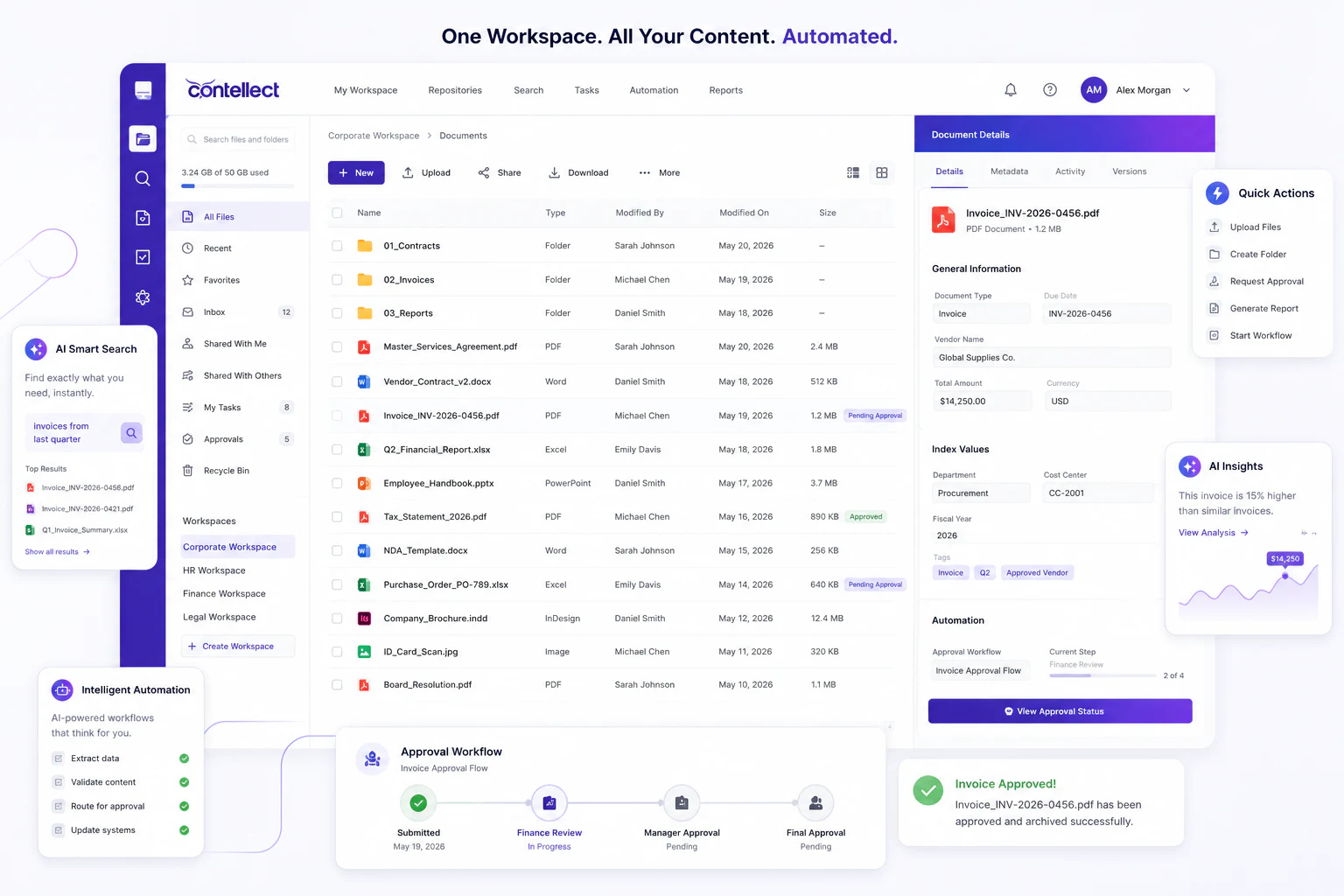
Contellect One brings document and content management, intelligent capture, automation, governance, enterprise search, and AI-assisted knowledge access into a secure information lifecycle. Agencies can modernize priority services while preserving authoritative systems, human accountability, and the records needed to explain every outcome.
A practical first initiative
Select one document-intensive service with a visible backlog and a committed process owner. Baseline the workload, turnaround time, error rate, exception rate, employee effort, citizen impact, and compliance controls. Map the information journey and identify one bounded stage where classification, extraction, validation, or routing can reduce friction.
Pilot with real exceptions, test security and fallback behavior, and require evidence at every decision gate. If the initiative improves service while preserving control, reuse the integration and governance patterns for the next process.
Government information modernization does not need to begin with a system-wide replacement. It can begin with one service, one defensible information flow, and one measurable improvement that builds confidence for what comes next.