Document Management vs Content Services
Understand document management, content management, information management, and content services, including their scope, capabilities, and best-fit use cases.

Document management, content management, information management, and content services are often used as if they describe the same thing. They do not. They overlap, and a single modern platform may support all four, but each term starts from a different question.
Document management controls business documents. Content management handles a wider range of digital content. Information management governs information across the organization. Content services delivers reusable content capabilities to applications and processes.
The practical goal is not to select the most fashionable label. It is to identify which capabilities your organization needs, where governance applies, and how content must move across systems.
The short answer
| Approach | Primary focus | Typical scope | Best fit |
|---|---|---|---|
| Document management | Controlled documents and their versions | Contracts, invoices, policies, case files, office documents | Teams that need capture, versioning, approval, retrieval, and audit trails |
| Content management | Digital content in multiple formats | Documents, images, audio, video, web and collaborative content | Organizations managing varied content and publishing or collaboration workflows |
| Information management | Enterprise information as a governed asset | Structured and unstructured information across systems | Leaders responsible for ownership, quality, security, privacy, retention, and value |
| Content services | Modular content capabilities for applications | Shared capture, repository, search, workflow, records, and API services | Enterprises connecting content to multiple processes, apps, and repositories |
These are scopes and architectural ideas, not mutually exclusive product boxes. A content services platform may deliver document management features, support a content management strategy, and enforce an information management policy.
Why the terminology became confusing
Organizations first needed to digitize paper and retrieve scanned images. Document imaging systems grew into document management systems with indexing, version control, check-in and check-out, and workflow. As repositories expanded to include richer media and collaborative content, the market adopted content management and enterprise content management.
The next challenge was fragmentation. One enterprise might have a document repository for finance, a collaboration platform for teams, a case system for service delivery, and a records archive for compliance. Content services emerged as an architectural response: make capture, storage, retrieval, workflow, and governance available as reusable services instead of forcing every application to build its own repository behavior.
At the same time, information management remained the broader management discipline. It is concerned not only with software but also with policy, accountability, quality, risk, value, and lifecycle decisions across all information.
The labels therefore overlap because they evolved from connected problems. Buyers should compare capabilities and architecture rather than assuming a product’s category name proves what it can do.
What is document management?
A document management system provides controlled capture, organization, retrieval, editing, sharing, and retention for business documents. It replaces unmanaged drives and email attachments with a system that understands document identity and lifecycle.
The unit of work is a controlled document, such as an invoice, contract, policy, or case file.
Know the boundary: A traditional DMS may be less suited to web publishing, large media assets, composable services, or governance beyond its own repository.
What is content management?
Content management broadens the focus from documents to images, video, audio, web pages, learning materials, product assets, social content, and collaborative workspaces.
Format diversity, publishing, reuse, and collaboration are central to the work.
Verify the controls: Broad format support does not automatically include records management, process integration, or enterprise governance.
What is information management?
Information management is the organization-wide discipline for ensuring information is created, owned, protected, used, retained, and disposed of in ways that support the business.
It covers structured data and unstructured content across systems. A database record, an approval email, and the signed agreement attached to a case can all belong to the same information context.
Software applies the policy, but it does not replace policy. Strong information governance defines accountability and decision rights first.
What are content services?
Content services expose capture, storage, search, workflow, records, and security capabilities so multiple applications can use them through APIs, events, connectors, or embedded components.
Content must reach users inside many applications, and replacing every repository at once is impractical.
Architecture, not a deployment label: Content services does not automatically mean cloud, headless, or microservices. The defining idea is reuse.
How the four concepts fit together
They are not competing boxes. Each concept answers a different question about the same information estate.
How do we control an identifiable document and its lifecycle?
Operational layerHow do we manage more formats, channels, and experiences?
Experience layerWhat enterprise rules, ownership, and outcomes apply?
Governance layerHow do applications and processes consume those capabilities?
Delivery layerInvoice control + supporting content + retention policy + ERP-connected services = a complete, governed process.
The storage and retrieval trade-off
Every information system balances the effort required to store content correctly with the effort required to retrieve it later. Deep folder structures and mandatory metadata can improve order but slow users down. Minimal filing effort feels easy at capture and creates confusion at retrieval.
Modern platforms reduce this tension through automation:
- intelligent data capture extracts metadata at ingestion;
- document classification applies a consistent category;
- entity recognition connects content to customers, cases, assets, and transactions;
- semantic search handles concepts and synonyms rather than exact keyword matches;
- workflow captures context as work happens;
- lifecycle rules apply retention without asking users to memorize schedules.
Automation does not eliminate information architecture. It makes a well-designed taxonomy and metadata model easier to apply. Requiring ten fields that nobody understands still produces poor information, even when the form blocks submission.
Capability comparison for buyers
Use this table to turn category language into testable requirements.
| Capability | DMS emphasis | Content management emphasis | Information management emphasis | Content services emphasis |
|---|---|---|---|---|
| Capture and OCR | High | Medium | Policy and quality oversight | Reusable capture service |
| Version control | High | High | Defines authoritative status | Shared version service |
| Multi-format content | Medium | High | Covers all relevant formats | Format-independent APIs |
| Workflow and case work | High | High | Defines controls and accountability | Composable process services |
| Records and retention | High in regulated DMS | Varies | Enterprise lifecycle policy | Policy enforcement across apps |
| Search and findability | Repository focused | Multi-content focused | Cross-system and contextual | Federated or embedded retrieval |
| Integration | Connectors to business apps | Publishing and collaboration links | Enterprise architecture view | API-first reuse across applications |
| Governance | Applied to documents | Applied to managed content | Organization-wide discipline | Consistent controls as services |
Which approach does your organization need?
Choose document management first when
- employees cannot find the current version of a business document;
- approvals happen in email with no reliable audit trail;
- paper and scans create manual indexing work;
- contracts, invoices, policies, or case files need controlled lifecycle management;
- retention and access rules must apply at document level.
Prioritize broader content management when
- teams manage many content formats and channels;
- publishing, collaboration, reuse, or digital asset workflows are central;
- document controls are necessary but do not cover the full content estate.
Lead with information management when
- the problem spans repositories, databases, policies, teams, and ownership;
- privacy, security, records, quality, and AI readiness require a common operating model;
- the organization needs enterprise standards before selecting or consolidating tools.
Favor content services architecture when
- content must appear inside many business applications;
- multiple repositories cannot be replaced at once;
- developers need consistent APIs for capture, retrieval, workflow, and governance;
- the organization wants to modernize processes without creating another isolated content silo.
Most enterprises need a combination. The useful question is not “DMS or content services?” It is “Which document and governance capabilities must be delivered as shared services, and which user experiences should consume them?”
Eight questions to ask vendors
Move beyond category labels. Ask each vendor to demonstrate these capabilities on your content and processes.
Content and lifecycle
What content types and lifecycle states can the platform manage natively? Test drafts, records, compound documents, email, media, and large files.
Authoritative status
How does the platform distinguish current, approved, superseded, and disposed content for both users and AI systems?
Metadata quality
Can metadata be automated and corrected? Test extraction, confidence scoring, bulk updates, taxonomy change, and reviewer feedback.
Permission-aware search
How does search handle synonyms, filters, effective dates, repository boundaries, and changing access rights?
API and embedding
What can applications call or embed? Inspect documentation, rate limits, events, stable identifiers, retries, and idempotency.
Records controls
How are retention and legal holds enforced? Confirm inheritance, exceptions, audit evidence, and disposition approval.
Accessible experiences
Test keyboard navigation, screen readers, contrast, zoom, language support, and document accessibility.
Year-three cost
Include migration, integration, storage, API usage, administration, upgrades, review queues, and support.
A phased modernization roadmap
Progress from a governed baseline to reusable enterprise services. Each phase has a clear deliverable.
Inventory outcomes and obligations
Map processes, content, repositories, owners, integrations, security, records duties, and accessibility needs.
Deliverable: prioritized service scopeDefine the information model
Agree on types, metadata, identifiers, relationships, authority, permissions, retention triggers, and quality.
Deliverable: minimum information contractTest one end-to-end process
Use real exceptions and the actual system of record. Measure cycle time, retrieval, effort, error, and audit evidence.
Deliverable: measured proof of valueIntegrate before replacing everything
Introduce shared services through APIs and connectors while existing systems continue to operate safely.
Deliverable: controlled coexistenceMove content with its context
Preserve versions, metadata, relationships, permissions, retention status, and audit evidence. Reconcile before retirement.
Deliverable: verified migrationReuse proven controls
Standardize connectors, models, permission patterns, workflows, audit schemas, accessibility checks, and monitoring.
Deliverable: reusable service foundationWhere Contellect One fits
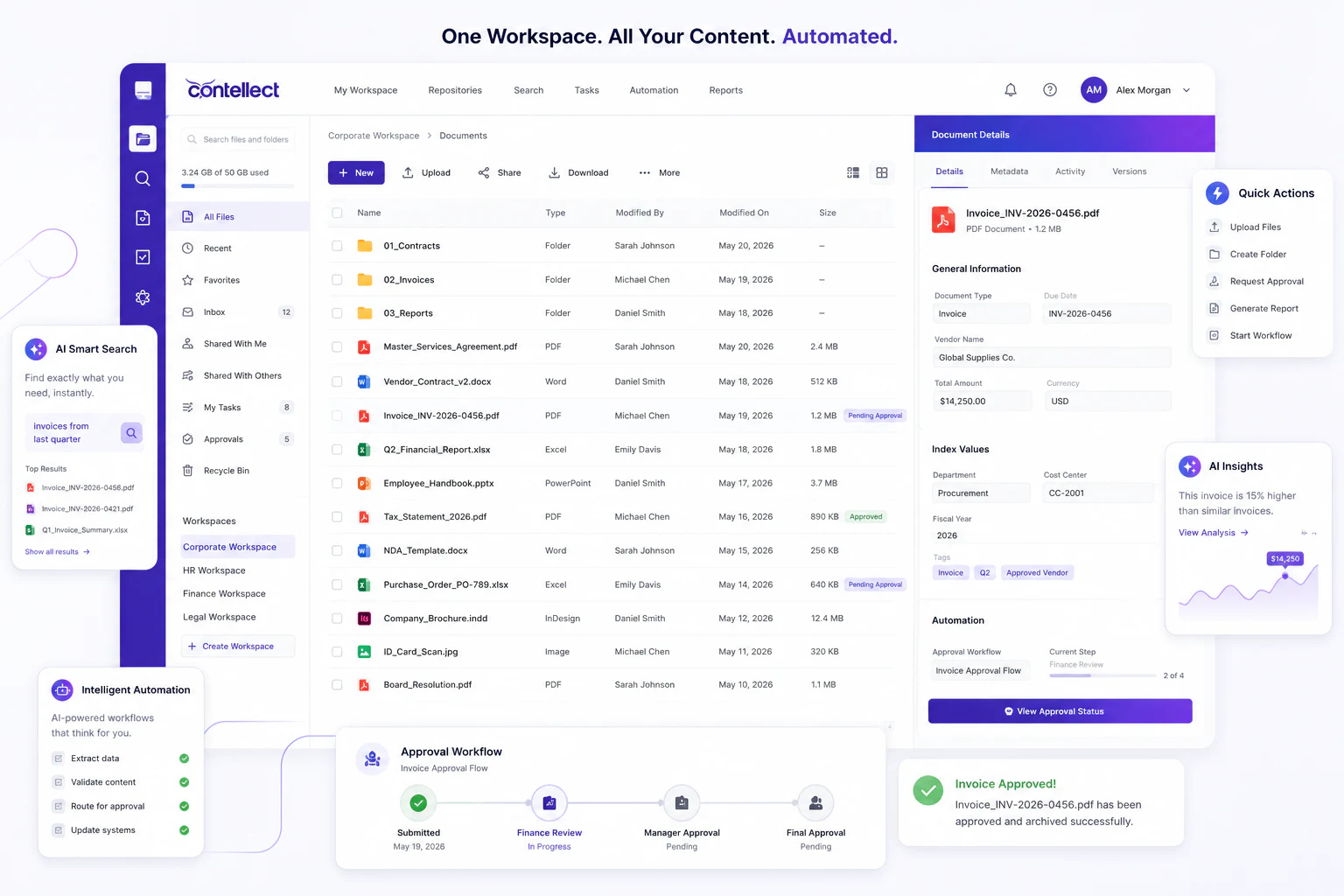
Contellect One brings document management, broader content control, enterprise search, intelligent capture, records governance, workflow, and integration into one secure workspace. Teams can manage documents directly while business applications consume content capabilities through connected processes.
That combination matters because modern information work crosses category boundaries. Capturing a document without governing it creates risk. Governing content without making it findable creates friction. Connecting an AI assistant without authoritative versions and permissions creates unreliable answers.
The right platform should make these concerns work together. If you are assessing your current environment, contact the Contellect team and use the eight vendor questions above against your own content, applications, and lifecycle rules.