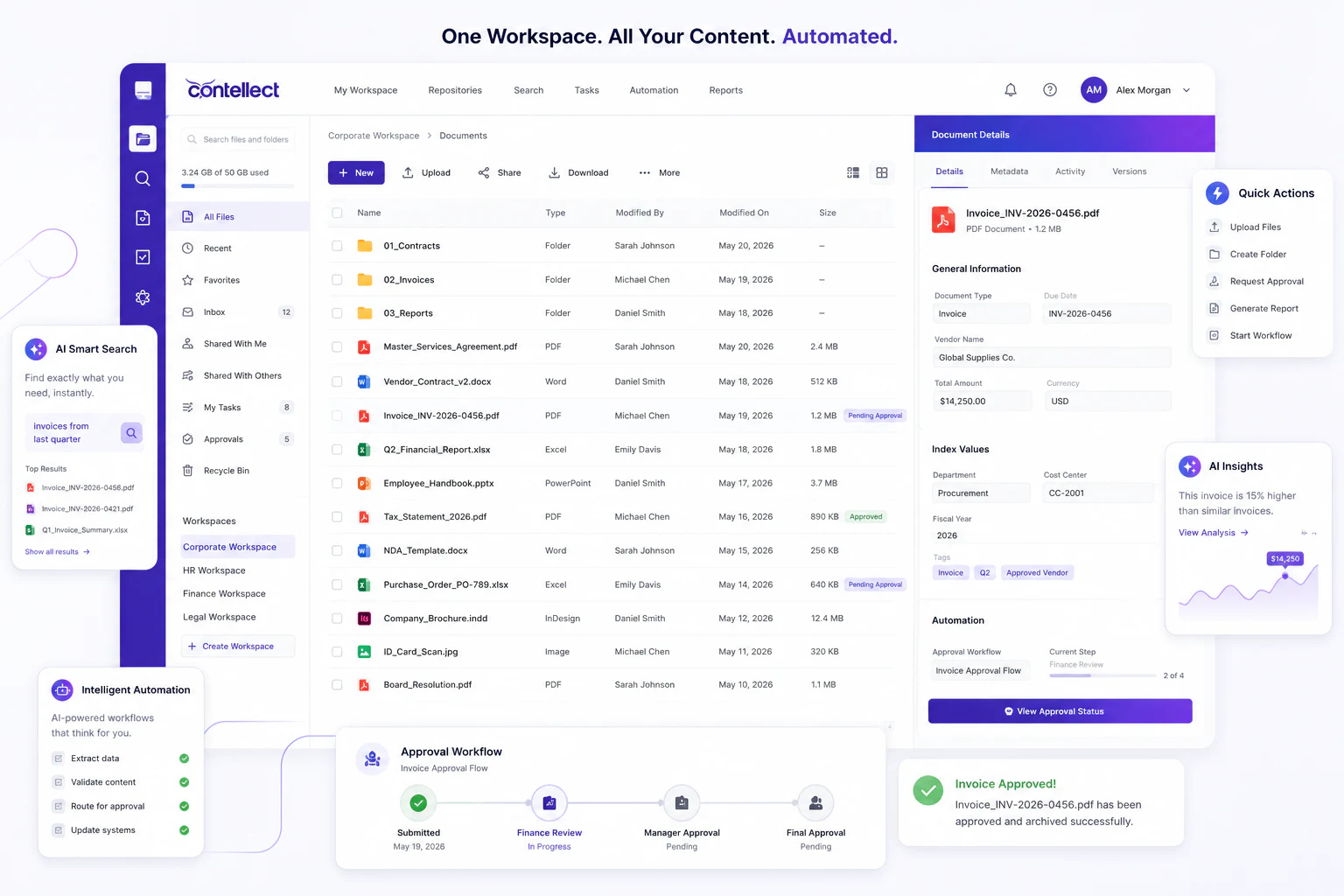
A content services platform (CSP) is a set of services for storing, governing and working with enterprise content, designed to be consumed through APIs by other applications rather than used only as a standalone repository.
The term was introduced by industry analysts to replace enterprise content management, and the renaming marked a genuine architectural shift rather than only a change of label.
What changed from ECM
ECM, as it was built in practice, assumed one repository. Content was migrated into a single system from a single vendor, and applications that needed it either integrated with that system or worked around it. The appeal was control. The cost was that migration projects were long, expensive and frequently incomplete, leaving content stranded in the systems it was supposed to replace.
The content services model starts from the observation that content is already distributed and will remain so. Rather than consolidating everything, it provides services that apply consistent governance across repositories, and exposes them so that content management becomes a capability other applications call rather than a destination users visit.
The practical consequence: success is no longer measured by how much content was migrated into one place, but by how consistently policy is applied wherever content lives.
Typical capabilities
Secure workspaces group content by team, case, matter or project, with membership and permissions scoped to that container. This suits the way work actually organizes itself better than a global folder tree.
Role-based access assigns rights by role rather than to named individuals, which is what makes periodic access review feasible. See document management system.
Retention policies apply lifecycle rules by content class, feeding records management where formal record declaration is required.
Integrations connect line-of-business systems so content is created and consumed in the applications where work happens, rather than requiring users to visit a separate repository.
API-first architecture is the defining characteristic. Every capability available in the interface is available programmatically, which is what allows content services to be embedded in other software.
Metadata and classification services apply consistent labels across sources, often using document classification so that governance does not depend on users tagging content correctly.
The federation trade-off
Applying governance across repositories rather than consolidating them avoids migration, and introduces its own difficulties. These deserve stating plainly, because vendor material tends not to.
Policy enforcement is only as strong as the weakest connector. If a repository exposes no API for applying retention, that content is governed by convention rather than by the platform.
Search across federated sources is harder than search within one index, and results quality varies with each source’s metadata discipline.
Access control has to be reconciled between systems with different permission models, and the reconciliation is where errors concentrate. A user who should not see a document usually gains access through a mismatch between two systems’ models rather than through a mistake in either one.
Federation is the right default for most organizations, but it trades a large migration project for a continuing integration burden. It is not the elimination of work.
Where CSP meets document AI
A content services platform governs content. Interpreting it is a separate capability: intelligent document processing converts documents into data, and retrieval-augmented generation answers questions from content.
The connection that matters is access control. If a retrieval system searches content the platform governs, the platform’s permissions have to be enforced at retrieval time, or the AI layer becomes a route around the governance the platform exists to provide.
What commonly goes wrong
It is bought as a repository and used as one. An API-first platform used only through its own interface delivers the same value as the ECM system it replaced, at the same cost.
Governance is assumed to be inherited. Connecting a repository does not automatically apply policy to its existing content; backfilling classification and retention to content already in place is usually the larger part of the work.
Workspaces proliferate. Without lifecycle rules, per-project workspaces accumulate indefinitely and reproduce the sprawl the platform was meant to resolve.
Contellect One provides these services in document and content management.