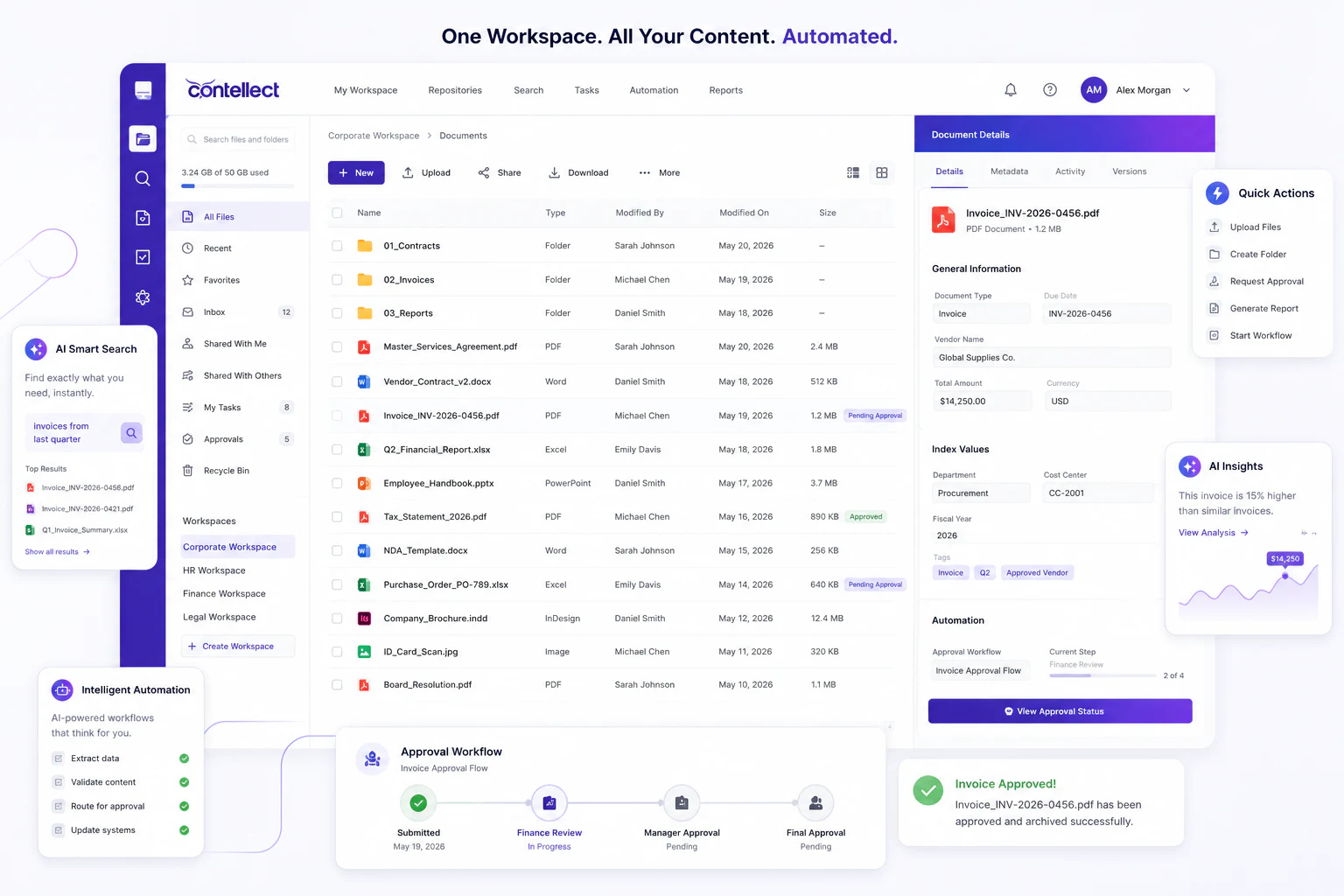
A document management system (DMS) is software that stores documents as controlled objects, tracking their versions, permissions, retention and history rather than holding them as ordinary files.
The distinction from a shared drive is control rather than storage. A file server holds bytes at a path. A DMS holds a document with a version history, an access policy, a retention rule and a record of who did what to it.
Core capabilities
Versioning keeps prior states retrievable and identifies the current one. This removes the filename-as-version-control convention that produces documents called final-v3-revised-JS.
Check-in and check-out prevents two people editing simultaneously and losing one set of changes. Modern systems often replace explicit locking with concurrent editing plus conflict resolution, but the underlying requirement is the same.
Access control governs who may see, edit, approve or delete, usually by role rather than by naming individuals. Permission at the document or folder level is the minimum; sensitive content often needs field-level or section-level restriction.
Retention attaches a lifespan to a document, after which it is disposed of or reviewed. This is where a DMS meets records management, though the two are not the same thing.
Search covers both metadata and full text. Full-text search depends on the content being machine-readable, which for scanned material means it has been through optical character recognition first.
Audit trail records access and modification with enough fidelity to answer an auditor’s question months later: who opened this, who changed it, when, and from where.
How DMS, ECM and CSP relate
The terminology in this area has shifted twice, and older documentation uses the earlier words, so the lineage is worth knowing.
Document management was the original scope: storing and controlling documents.
Enterprise content management (ECM) broadened it during the 2000s to cover all content types alongside the processes acting on them, including web content, records, imaging and workflow. In practice ECM came to describe large, centralized, single-vendor repositories.
Content services platform (CSP) is the term that succeeded ECM in analyst usage. The shift was not only vocabulary. It reflected a move away from one monolithic repository toward a set of services, accessed by API, that can operate over content held in several places. See content services platform.
The categories are not cleanly separable, and vendors apply whichever label currently sells. A pragmatic reading: DMS describes a capability set, ECM describes an era of architecture, CSP describes the current architectural expectation.
What a DMS does not do
A DMS controls documents. It does not interpret them. Storing an invoice with correct permissions and a retention rule does not extract its total or route it for approval; that requires intelligent document processing and workflow automation.
This boundary is where implementations most often disappoint. An organization migrates to a DMS expecting less manual work and finds it has better-governed manual work, because governance and automation are different problems.
What commonly goes wrong
The folder structure is migrated unchanged. Lifting an existing shared-drive hierarchy into a DMS reproduces its problems with added overhead. Metadata-driven organization is the point; recreating folders defeats it.
Metadata is optional. If capture is not enforced at the point content enters, it will not be applied later. A repository with sparse metadata degrades to a search-only system.
Permissions are assigned per person. Individual grants become unmaintainable as people change roles and leave, and they are the usual reason an access review cannot be completed. Role-based assignment is the alternative.
Retention is configured but never triggered. A retention schedule that no process acts on provides the appearance of governance without its substance, and leaves content that should have been disposed of discoverable in litigation.
Search is assumed to work on scanned content. Documents captured as images are invisible to full-text search until they have been recognized, which is a common and unwelcome discovery after migration.
Contellect One provides these controls in document and content management.