Process Templates
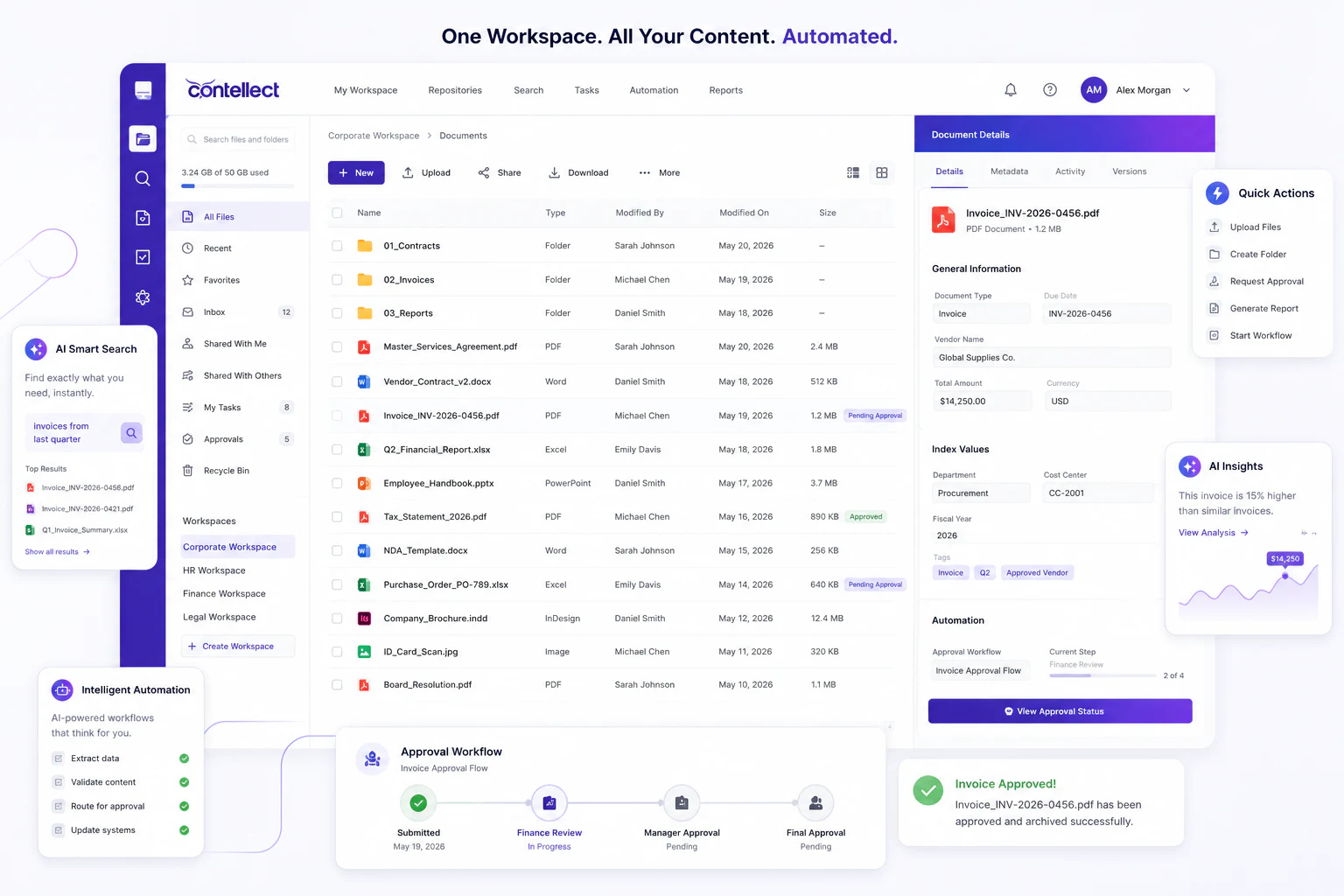
Create reusable patterns for approvals, reviews, records, cases, requests, and exceptions.
Design reusable workflow patterns, process rules, approvals, integrations, monitoring, and exception handling with the Contellect One Automation Framework.
An automation framework is a reusable foundation for designing, running, monitoring, and governing business workflows. Contellect One provides workflow patterns, rules, approvals, integrations, document actions, and audit controls so teams can scale automation without rebuilding every process from scratch.
The Automation Framework gives teams consistent building blocks for content-heavy workflows across departments.
Create reusable patterns for approvals, reviews, records, cases, requests, and exceptions.
Apply routing logic, SLAs, required evidence, thresholds, and policy conditions.
Connect documents and workflow state to CRM, ERP, HR, finance, email, and APIs.
Track work queues, bottlenecks, overdue tasks, exceptions, and audit trails.
Contellect One helps teams design, launch, monitor, and improve automated work.
Define process steps, owners, forms, documents, systems, rules, and outcomes.
Set permissions, SLAs, routing, notifications, approvals, and exceptions.
Link repositories, forms, generated documents, AI extraction, and enterprise applications.
Launch workflows from forms, documents, cases, emails, events, or system triggers.
Track status, workloads, audit trails, approvals, and exceptions in real time.
Use workflow analytics and feedback to remove bottlenecks and standardize best practices.
Use a consistent automation foundation for repeatable processes across the organization.
Route contracts, policies, invoices, reports, and generated documents through controlled review.
Move customer, employee, citizen, supplier, and service requests through queues and SLAs.
Collect, validate, approve, retain, and archive records and compliance evidence.
Launch workflows from eForms with required data, attachments, validation, and routing.
Use extraction, summaries, search, and agentic actions inside governed workflow patterns.
Synchronize workflow events with CRM, ERP, HR, finance, and collaboration tools.
Teams reuse approved workflow patterns instead of creating disconnected processes.
Common rules, forms, approvals, and integrations reduce implementation time.
Audit trails, permissions, retention, and exception handling are built into each workflow.
Monitoring reveals bottlenecks, rework, overdue tasks, and opportunities for automation.