Document Digitization: The Lifecycle Gap
Digitization projects end. The record does not. Why the link between paper originals and digital surrogates breaks, and what keeps both governed.
Key Takeaways
- Digitization is funded and measured as a project, while the record it produces has a lifecycle that continues.
- The capture specification is evidence. Stored in a vendor’s closed ticket, it cannot separate a deliberate exclusion from an oversight.
- Originals and surrogates often carry different retention rules, so one schedule rarely covers both.
- Destroying an original makes the capture decision permanent, because a re-scan is no longer possible.
- Reconcile at box, file and page level before disposal, or completeness cannot be proven again.
Document digitization is the conversion of physical records into digital form: capture, image processing, indexing and load. Modern capture handles mixed formats, poor originals and multiple languages well enough for production use, so the scanning itself is rarely where these programs fail.
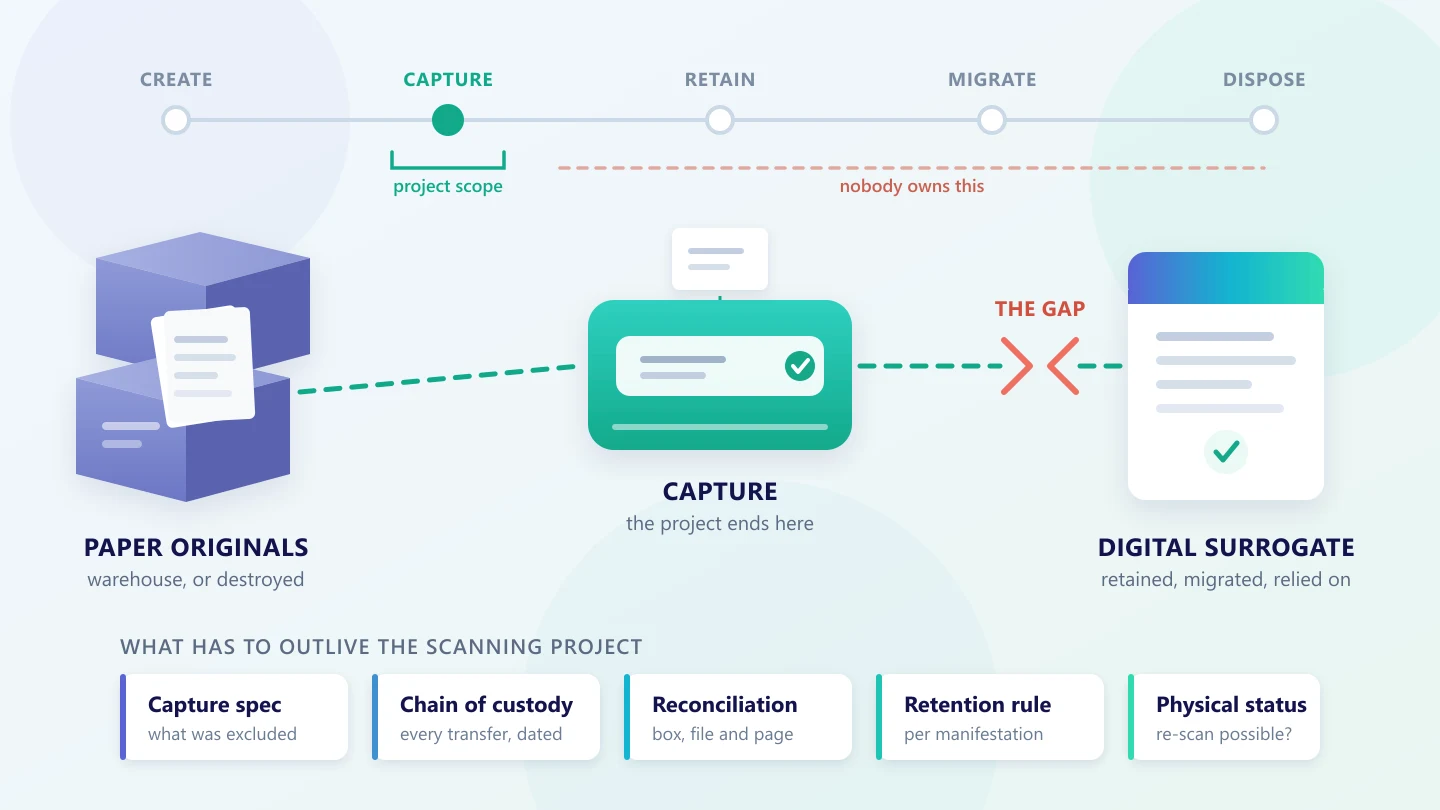
They fail afterwards. A digitization program is run as a project, with a start date, a page count and a completion report. A record does not work that way. It has a lifecycle that continues long after the scanner is returned, and the link between the paper original and its digital surrogate has to survive that whole period.
That link is the part nobody owns. Once the project closes, the images sit in a repository, the originals sit in a warehouse or a skip, and the decisions that connected them live in an email thread or a vendor’s ticketing system. The organization ends up holding two things it can no longer reason about together.
Why the gap exists
Digitization is funded as a cost-reduction exercise. The business case is usually floor space, retrieval time, or a warehouse contract that is ending. Those are legitimate drivers, and they set a deadline. The program is then measured on throughput: images per day, boxes cleared.
None of those measures capture whether the resulting digital record is governable. A project can hit every throughput target and still leave an estate where nobody can answer three basic questions: which original does this image correspond to, what was deliberately not captured, and is the paper still in existence. The people who could answer them are frequently contractors who leave when the project ends.
This is a different problem from scan quality. A 300 dpi bitonal image can be perfectly adequate and still be an ungovernable record, because adequacy depends on what the image will later be asked to prove.
Where the link breaks
The capture specification is discarded
Every digitization program makes dozens of capture decisions: resolution, color depth, whether reverse sides are captured when blank, whether annotations and sticky notes are imaged, how oversized drawings are handled, whether staples and bindings are removed, how poor originals are flagged rather than rejected. Those decisions define the boundary of what the digital record can ever show.
In most programs that specification exists as a contract annex. It is not stored with the images and it is not surfaced to anyone who later searches them. A future reader therefore cannot distinguish something that was deliberately excluded from something nobody thought to capture. The two look identical in the repository and mean completely different things in an audit.
Chain of custody stops at the loading dock
Boxes leave a site, get split into batches, get re-sequenced for throughput, and come back in a different order, if they come back at all. Unless custody is recorded at each transfer, the organization cannot later show that a given file was intact when it was captured. Files pulled for legal or operational reasons mid-project frequently never rejoin the sequence.
Disposal of originals is an undocumented decision
The moment originals are destroyed is the most consequential event in the program, and it is often recorded only as an invoice for shredding. What should be recorded is narrower and more useful: which originals were destroyed, on whose authority, against which certified capture, and with which exceptions held back. Without that, the surrogate carries an implied claim it cannot support.
The surrogate has its own lifecycle and nobody scheduled it
A digital surrogate is not permanent. Formats age, repositories get replaced, and the metadata that made an image findable often lives in the application rather than with the file. An organization that destroyed its originals in year one can find, in year eight, that the only copy is trapped in a system nobody will migrate. Digitization moves the preservation problem; it does not remove it. The discipline that owns what happens next is digital preservation, and the stage model it belongs to is document lifecycle management.
What a linked record actually requires
The objective is narrow. A person or a system should be able to start from either the original or the surrogate and reach a complete, current answer about the other. That requires a small number of things to be stored together and kept current.
| What to link | What to store with it | Why it matters later |
|---|---|---|
| Identity | A persistent identifier for the intellectual record, not a file path | Paths break on every migration, so a path-based link rots quietly |
| Capture parameters | Resolution, color depth, format, capture date, device, operator or vendor | Establishes what the image can and cannot be asked to prove |
| Scope decisions | What was excluded and why, including blanks, annotations and oversized items | Separates a deliberate exclusion from an oversight |
| Custody | Each transfer of the physical original, with dates and responsible parties | Supports a completeness claim under challenge |
| Reconciliation | Expected and actual counts at box, file and page level, plus exceptions | Proves nothing was silently dropped |
| Physical status | In storage, returned to business, destroyed, or held as an exception | Answers whether a re-scan is even possible |
| Retention | The rule applied to the original and the rule applied to the surrogate | The two are frequently not the same |
None of this is exotic metadata. It is the operational record of the digitization itself, and it is usually captured somewhere already. The failure is that it is captured in project artifacts rather than against the records.
The original and the surrogate are not the same record
Teams often assume that once an item is scanned, one retention rule covers both copies. In practice the rules diverge, and the divergence is where risk sits.
Some record classes are subject to requirements to retain an original form, or to retain it for a defined period after certified capture. Others allow substitution only where the capture process itself is certified and evidenced. Meanwhile the surrogate may need to be retained longer than the original, because it has become the working copy that business processes depend on.
A retention schedule written for paper therefore needs a second column, not a search and replace. The question changes from how long do we keep this, to how long do we keep each manifestation, and what evidence supports treating the digital one as sufficient. An organization that destroyed originals under a general substitution assumption can find that a specific class required an overlap period it never observed. The mechanics of schedules, triggers and defensible destruction sit under records management, and the accountability for who may authorize any of it sits under information governance.
Closing the gap in an existing estate
Most organizations reading this already have a scanned estate with a broken link. The work is remediation rather than design, and it is worth sequencing by exposure rather than by volume.
Start with what cannot be recovered
Identify record classes where originals have already been destroyed. Those are the ones where capture decisions are now permanent and where any gap in the surrogate is unfixable. Establish what is actually known about their capture and record it against the records. Where the specification cannot be recovered, say so explicitly, because a documented unknown is more useful than a silent assumption.
Then secure what is still reversible
For classes where originals still exist, the gap is recoverable. Reconcile counts, confirm physical status and location, and record the retention rule for each manifestation before any further disposal is authorized. Pause disposal on any class where reconciliation does not close.
Only then improve findability
Retrofitting classification and metadata is valuable, but it is second. A well described record whose original was destroyed under an undocumented specification is still an evidential problem. Capture at the point of ingestion is the durable fix for new intake, and the guide to intelligent data capture covers how that is applied in practice.
Name an owner who outlives the project
The structural fix is a named owner for the digitized estate after the program closes, with the specification, custody records and reconciliation results held as records in their own right. Without that role, the gap reopens with the next intake.
Making it operational
Contellect One is built to keep physical and digital manifestations governed as one record rather than two disconnected assets. Intelligent document processing, data extraction, automated classification, metadata intelligence and retention control mean capture parameters, custody, reconciliation results and physical status are held against the record instead of in project paperwork.
If you are planning a digitization program, or remediating one that has already closed, the platform supports the lifecycle after the scanning stops, which is where the evidential value is won or lost. The delivery view of this work sits in document digitization, and the wider repository context in the document management system guide.