Digital preservation is the set of practices that keep digital records usable over time, as the file formats, storage media, software and metadata they depend on fall out of support.
The defining feature is that preservation targets future usability rather than present availability. A file that opens today and cannot be opened in fifteen years has been stored, not preserved.
Preservation is not backup, and not digitization
These three are routinely conflated, and each solves a different problem.
Backup protects against loss. It restores yesterday’s state after deletion, corruption or hardware failure. Its horizon is days or weeks, and it faithfully preserves the original format, which is exactly the thing that becomes unreadable. A thirty-year-old backup of an unsupported format is a preserved copy of a problem.
Digitization creates a digital copy of something physical. It moves the record into digital form and, in doing so, moves the preservation obligation onto the digital copy rather than removing it. Organizations that destroyed paper originals after scanning have made preservation of the surrogate mandatory, because it is now the only manifestation.
Preservation keeps the content interpretable. It accepts that formats, codecs, character encodings and rendering software will be abandoned, and it plans for the transitions.
What actually decays
Format obsolescence. The software that reads a format stops shipping, or new versions drop support for old files. Proprietary and version-specific formats fail sooner than open, documented ones.
Media decay. Optical discs, tape and drives all degrade, and tape formats become unreadable when the drives are no longer manufactured. Storage media are a shorter-lived commitment than the retention periods they are asked to hold.
Metadata separation. Frequently the most damaging. The bytes survive but the context does not: the identifier, the classification, the date, the relationship to other records. A preserved file that cannot be identified is not usefully preserved, and metadata held in an application rather than alongside the content is lost when the application is retired.
Loss of the rendering environment. Some records are only meaningful inside the system that produced them. A form, a spreadsheet with live formulas or a database extract may preserve its bytes and lose its meaning.
The core practices
Format policy. Preferred formats for long-term retention, chosen for openness and documentation rather than for convenience at the point of creation.
Fixity checking. Cryptographic checksums recorded at ingest and verified on a schedule, which is how silent corruption is detected while a good copy still exists. Without fixity, corruption is discovered at the moment of retrieval, which is the moment it matters and the moment it cannot be repaired.
Migration. Converting content to current formats before the old ones become unreadable. Migration is lossy for some content types, so what is acceptable to lose has to be decided in advance rather than discovered afterwards.
Emulation. Reproducing the original environment instead of converting the file. Used where the rendering environment is part of the record.
Significant properties. An explicit statement of what must survive a migration: the text, the layout, the signature, the formulas, the color fidelity. Migrations without this are judged against nobody’s expectations, and quietly lose the property that mattered.
Where it meets retention and governance
A retention period is a preservation commitment. Committing to keep a record for twenty years commits the organization to two or three format migrations within that window, and records management schedules rarely name who performs them.
The same disconnect shows up in information governance frameworks that set long retention with no format policy behind it, and in document lifecycle management models that treat migration as an infrastructure event rather than a lifecycle stage with evidential consequences.
What commonly goes wrong
Preservation is assumed to be storage. Content is placed in a repository and considered handled. No format policy, no fixity, no migration plan, and no owner after the project that loaded it.
Fixity is never verified. Checksums are recorded at ingest and never checked again, which detects nothing.
Migration is deferred until the format fails. By the point a format cannot be opened, the tooling to convert it has usually also gone.
The only copy is trapped in a retiring system. Discovered during decommissioning, when the migration budget has already been spent and the timeline is fixed.
Nobody owns it. Preservation is a standing obligation and is usually funded as a project, so it lapses the moment the project closes.
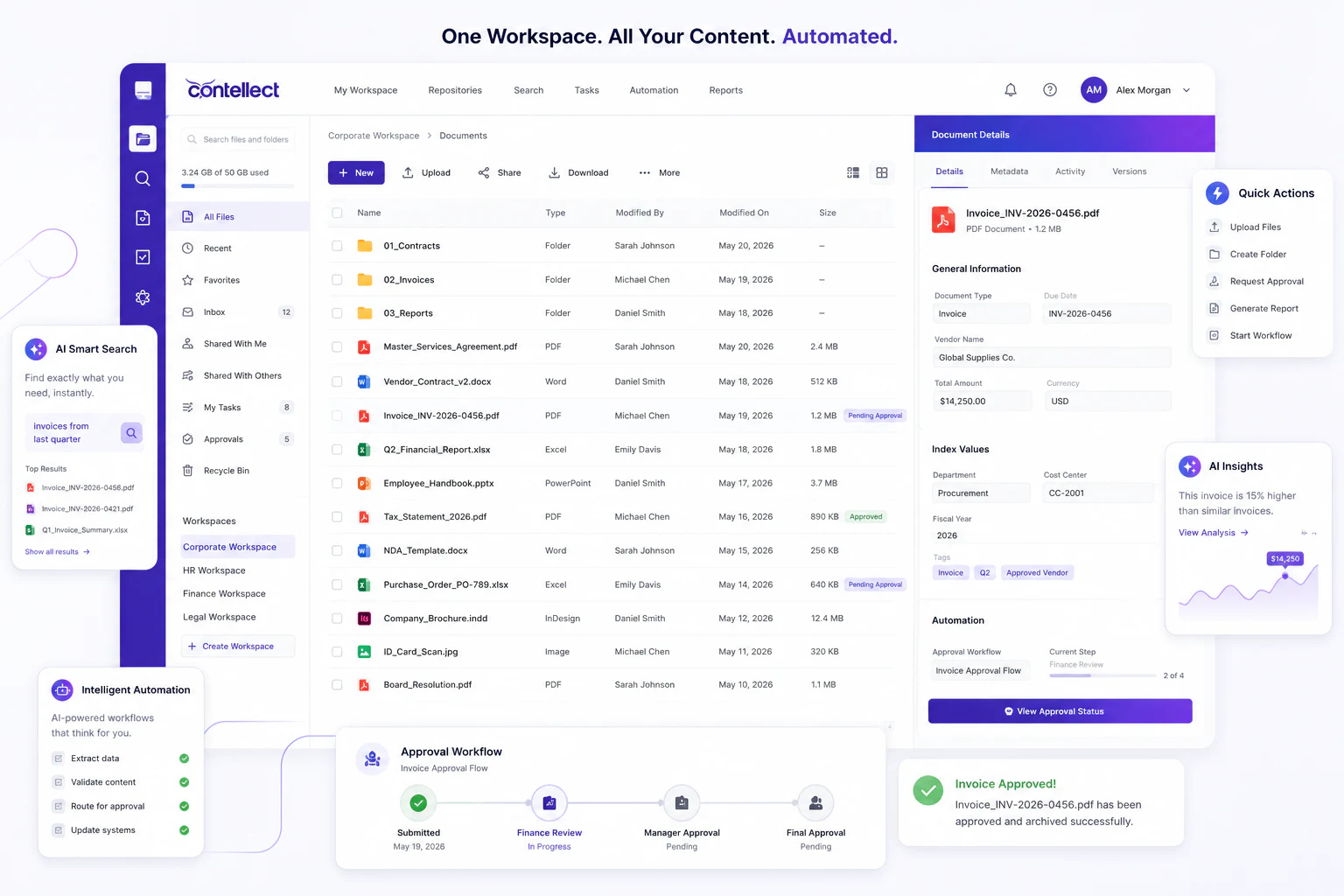
Contellect One holds content, metadata and audit history together rather than in the application layer, which is the dependency that breaks first, as part of digital archiving.