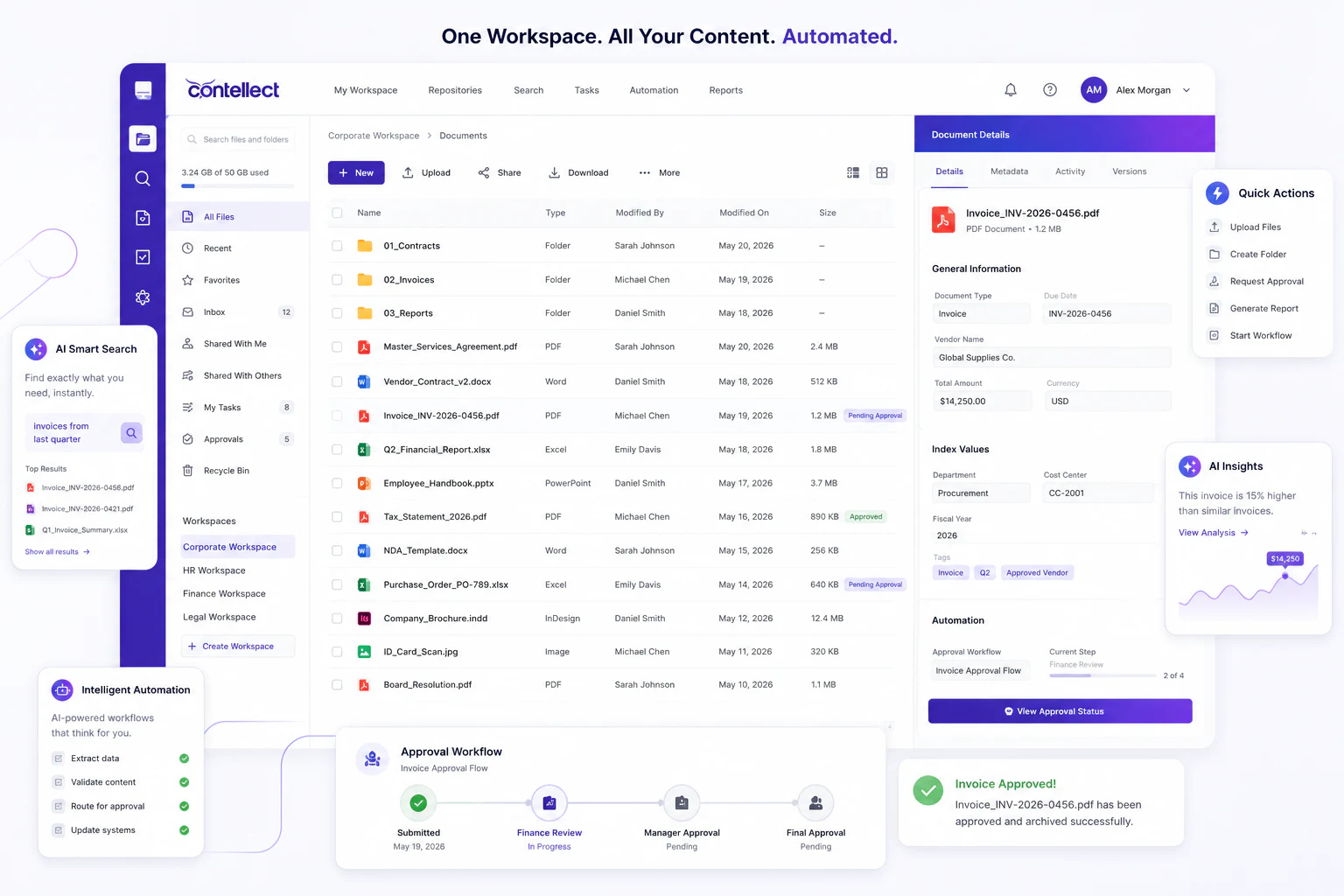
Document workflow automation is the orchestration of the steps a document passes through after capture, including routing, approval, exception handling and delivery to a system of record, with the sequence enforced by software rather than by people.
Automation here means the process advances itself. A person may still make decisions, but nobody is responsible for remembering what happens next or for moving work from one desk to the next.
The components
Routing determines where a document goes, based on what it is and what was extracted from it. An invoice under a threshold may post directly; one above it may need approval; one from an unrecognized supplier may need vendor onboarding first. Routing decisions depend on document classification and data extraction having already run.
Approvals capture a decision from a person with authority. The design questions are who approves what, whether authority varies by amount or type, what happens when an approver is unavailable, and whether approval can be delegated.
Exception handling covers everything that cannot proceed automatically: extraction confidence below threshold, validation failure, a reference that does not resolve, a document that should not have been sent. Exceptions are not edge cases; they are a permanent, sizeable proportion of volume and deserve as much design attention as the happy path.
Escalation moves work when it stalls. A step with no completion deadline becomes an indefinite queue, and the usual cause of a slow process is not slow work but work waiting on someone who does not know it is waiting.
BPMN-style orchestration
Business Process Model and Notation is a standard for describing processes as diagrams that are both human-readable and machine-executable. Its relevance is that the diagram is the implementation, so the process a business analyst draws is the process that runs.
The concepts that matter in document work are sequence flows, gateways for branching, parallel paths for steps that can run concurrently, timer events for deadlines and escalation, and compensation for undoing partially completed work when a later step fails.
The benefit of an explicit model is that the process can be reasoned about, versioned and audited. The risk is over-modeling: a diagram that captures every conceivable variation becomes unmaintainable, and the variations usually belong in configuration or in an exception path rather than as additional branches.
Not every process needs BPMN. A two-step review is better expressed as a two-step review. The standard earns its overhead when a process has genuine branching, parallelism and deadlines.
Straight-through processing rate
The metric that matters is the straight-through processing rate: the proportion of documents that complete the whole process with no human touch.
It is the right measure because it captures the actual benefit, which is human time not spent. Component metrics mislead. Extraction accuracy of 95 percent sounds strong, but if the remaining 5 percent lands in a queue that takes four minutes per document, the labor saving is smaller than the accuracy figure implies.
Two refinements make it useful in practice. Measure it per document type, since a blended rate hides the types that never automate. And pair it with the time cost of the exceptions, because a system with a 70 percent rate and fast review can beat one at 85 percent with a slow queue.
Raising the rate has two levers: better extraction and validation so fewer documents fall out, and lower confidence thresholds so fewer are held for review. The second is free and increases error rate, which is why thresholds should be set from the cost of errors rather than tuned to make the metric look better.
What commonly goes wrong
The exception queue is an afterthought. It is designed last, given the least attention, and becomes where the process spends most of its human effort.
No step has an owner. Work routed to a group with no individual accountable sits until someone volunteers.
The process is automated as it is. Encoding an existing manual process step for step preserves the approvals that existed because information was unavailable, not because the control was needed. Reviewing which steps are still justified is usually where the largest gains are.
Rework is invisible. A document that completes after three corrections counts as processed, and the corrections do not appear in any metric. Tracking touches per document surfaces this.
Success is measured in volume. Documents processed per hour rises when a queue is skimmed rather than reviewed. Pairing throughput with downstream error rate prevents rewarding that.
Contellect One orchestrates these steps in intelligent process automation.