Knowledge Enrichment for Enterprise AI
Learn how knowledge enrichment turns unstructured enterprise content into trusted, contextual, and AI-ready information for search and automation.

Enterprise AI rarely fails because an organization has too little content. It fails because the content is difficult to interpret. Policies sit beside superseded drafts, invoices arrive as scans, contracts use inconsistent names, and important context remains trapped in folders or in employees’ heads.
Knowledge enrichment turns that unstructured content into information that people and AI systems can use with confidence. It adds structure, metadata, recognized entities, relationships, provenance, and business context while preserving the source document. The result is not simply a better tag. It is a governed layer of meaning that improves search, automation, analytics, and AI-assisted work.
Key takeaways
- Knowledge enrichment connects content to its business meaning, not just its file properties.
- A practical pipeline combines capture, normalization, classification, extraction, entity recognition, contextual linking, and validation.
- Better context improves retrieval, reduces manual preparation, and gives AI agents safer boundaries.
- Governance remains essential because enrichment does not decide authority, access, retention, or acceptable use on its own.
- The best starting point is a bounded process with a measurable outcome, not an enterprise-wide tagging program.
What is knowledge enrichment?
Knowledge enrichment is the process of making unstructured content understandable in context. A basic repository may know that a file is a PDF, who uploaded it, and when it changed. An enriched system can also know that the file is an executed supplier agreement, that Acme Trading and ACME Ltd. refer to the same organization, that the agreement governs a particular purchase order, and that its renewal date is approaching.
That distinction matters. File metadata describes the container. Enriched knowledge describes what the content means and how it relates to work.
| Layer | Question it answers | Example |
|---|---|---|
| Technical metadata | What is the file? | PDF, 18 pages, created August 12 |
| Descriptive metadata | What is it about? | Supplier agreement for facilities services |
| Extracted entities | Which business objects appear? | Vendor, contract owner, jurisdiction, renewal date |
| Relationships | How is it connected? | Governs PO-1842 and supersedes agreement C-118 |
| Governance context | How may it be used? | Legal access group, seven-year retention rule |
| Operational context | What should happen next? | Alert the owner 90 days before renewal |
This is why knowledge enrichment is more than document classification. Classification determines what a document is. Enrichment builds the wider context needed to find it, compare it, reason over it, and trigger the right action.
Knowledge enrichment vs data enrichment
The terms sound similar but solve different problems.
Data enrichment typically improves a structured record by appending known values. A customer record may gain an industry code, geographic region, or company size from another database.
Knowledge enrichment starts with content whose meaning is not already arranged in rows and fields. It analyzes a document, email, image, transcript, or presentation, identifies what matters, and connects that meaning to a taxonomy, business object, process, or knowledge graph.
Both approaches improve information quality. The difference is the starting point and the depth of context. Data enrichment fills gaps in a schema. Knowledge enrichment helps create the schema and relationships from content that did not have them.
How the knowledge enrichment pipeline works
A reliable pipeline preserves evidence first, adds meaning in layers, and activates only validated knowledge. This prevents a polished AI experience from hiding weak context or access controls underneath it.
Ingest and preserve
Connect approved repositories, email, scanners, applications, and archives. Preserve the original, source location, timestamps, and chain of custody.
Output: traceable source contentNormalize the content
Apply OCR, split compound files, detect language, and standardize dates, units, and formats without erasing the original presentation.
Output: processable contentClassify the document
Identify document type and business category so the correct extraction, permission, and workflow rules can run with confidence thresholds.
Output: trusted document classExtract metadata and entities
Capture explicit values and recognize people, organizations, products, locations, dates, events, and business identifiers in narrative content.
Output: structured factsResolve relationships
Normalize name variants to shared identities and link documents to cases, customers, assets, transactions, policies, and related content.
Output: connected knowledgeValidate and govern
Apply business rules, confidence thresholds, permissions, retention mapping, human review, and model-version evidence.
Output: approved knowledgeActivate the knowledge
Write approved context back to systems of record and make it available to enterprise search, workflows, analytics, RAG, and authorized AI agents.
Outcome: better decisions and processesWhy knowledge enrichment matters for enterprise AI
Large language models are fluent, but fluency is not authority. An enterprise assistant must retrieve the correct policy version, respect document permissions, distinguish a draft from an executed agreement, and show where its answer came from.
Knowledge enrichment improves that environment in four ways:
- Retrieval precision. Search can combine semantic similarity with document type, entity, lifecycle status, effective date, and access rules.
- Grounding quality. AI receives the relevant passage plus the business context needed to interpret it.
- Explainability. Answers can point to an approved source and expose the metadata or relationship that led to it.
- Action safety. Agents can act within defined boundaries, such as starting a renewal workflow only for an executed contract with a validated date.
An AI assistant that retrieves every file containing “travel policy” may cite an obsolete draft. An enriched system can restrict retrieval to approved policies, current versions, the user’s jurisdiction, and the effective date of the question. That is the difference between plausible text and dependable operational support.
Business applications
Knowledge enrichment is useful wherever content volume and context meet.
| Function | Enriched knowledge | Business impact |
|---|---|---|
| Accounts payable | Supplier, invoice number, PO, amount, tax, approval state | Faster matching and fewer manual touches |
| Contract management | Parties, clauses, obligations, dates, related agreements | Earlier renewal action and clearer risk review |
| Insurance | Claim type, policy, loss location, damage evidence, claimant | Faster triage and more complete case files |
| Healthcare | Patient, encounter, document type, clinical context, sensitivity | Better retrieval with stricter access control |
| Customer service | Customer, product, issue, sentiment, prior case | Faster responses with relevant history |
| Engineering | Asset, drawing type, revision, project, approval status | Less time spent finding the current technical record |
The common pattern is that a document becomes more valuable when its meaning can travel with it. This supports document and content management while reducing the manual tagging that makes many repository programs stall.
A practical implementation roadmap
Build confidence in six controlled stages. Each stage creates the evidence and guardrails needed for the next.
Define a decision, not a technology target
Choose a measurable outcome such as reducing contract review time, improving first-pass invoice matching, or increasing successful self-service searches. Document the baseline and the cost of an incorrect result.
Establish a minimum metadata contract
List the smallest set of fields and relationships required for the use case. Mark mandatory values, the authoritative source, and the confidence threshold that permits automation.
Test representative content
Include poor scans, rare document types, multiple languages, handwritten additions, long documents, and real exceptions. Measure field-level precision and recall, not one average score.
Add human review where risk requires it
Route uncertain results with confidence thresholds. Capture each correction and its reason so models, rules, and taxonomy improve without turning review into hidden cleanup work.
Integrate with the system of record
Use stable identifiers and documented APIs. Prevent duplicate write-back, define retry behavior, and keep a trace from every enriched value to its source.
Monitor knowledge quality over time
Track exceptions, unsupported values, taxonomy drift, retrieval success, reviewer effort, and downstream corrections. Revalidate when a source, model, policy, or process changes.
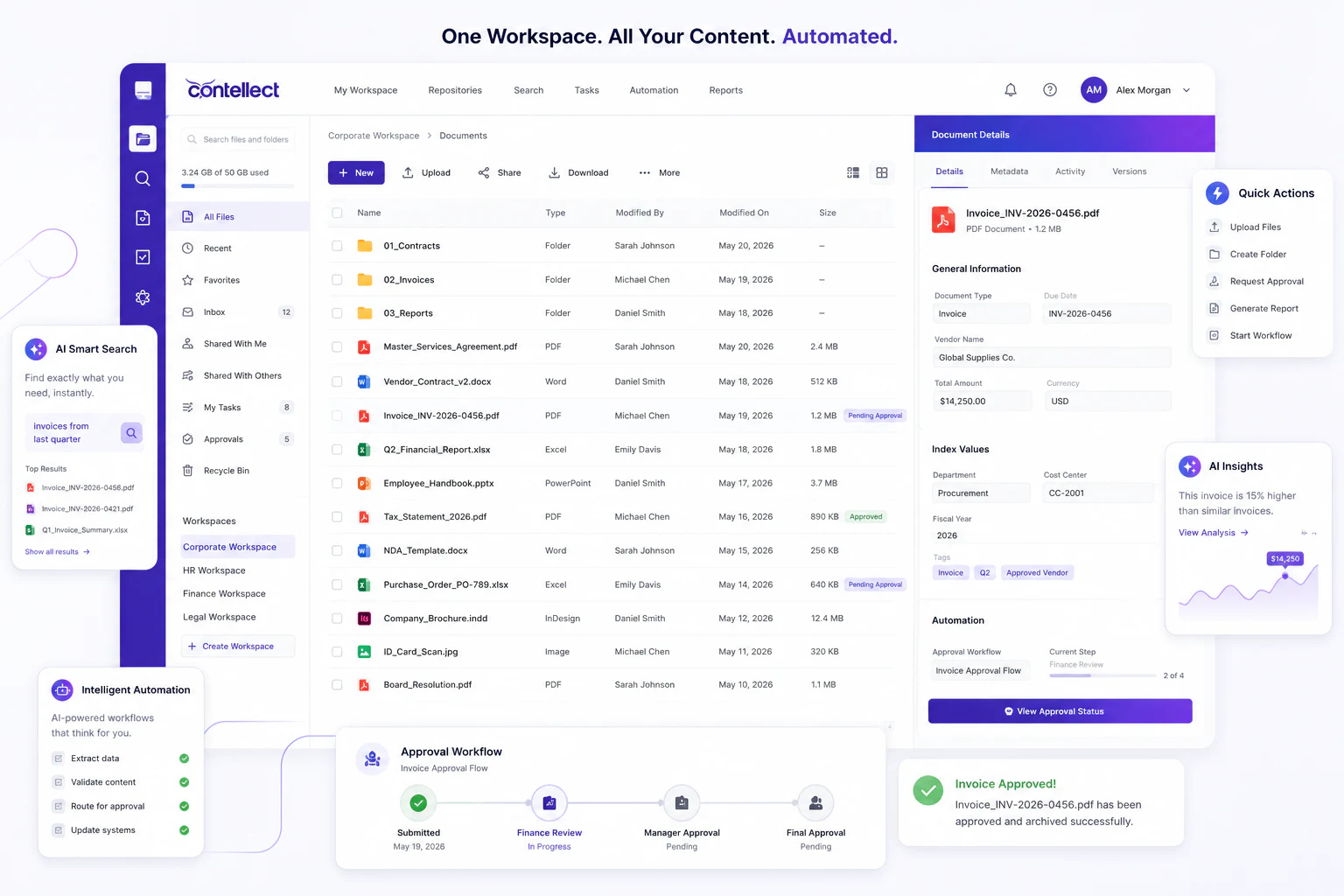
Platform connection: Contellect One combines intelligent data capture, content management, and workflow so enrichment can move from prediction to governed action.
Metrics that reveal real value
Do not evaluate enrichment only by how many tags a model creates. Use measures tied to quality and outcomes:
- field-level precision and recall for critical metadata;
- entity resolution accuracy;
- percentage of content processed without review;
- reviewer minutes per document;
- successful search rate and time to find an authoritative answer;
- reduction in incomplete submissions or downstream corrections;
- percentage of AI answers with valid, authorized citations;
- process cycle time and cost per completed case.
A high extraction score can coexist with poor business value if the enriched data never reaches the workflow, if users cannot trust it, or if the wrong source remains marked authoritative.
Risks and controls
Pair every known failure mode with a control that can be tested, owned, and audited.
False confidence
Require confidence scores, validation rules, and human review for consequential fields.
Permission leakage
Enforce source permissions during indexing and retrieval. Treat enriched metadata as sensitive as its source.
Unclear provenance
Store the source, model version, extraction time, and correction history for every derived value.
Taxonomy drift
Assign an owner and monitor new or ambiguous values instead of letting categories multiply without control.
Uneven performance
Test across document types, languages, channels, and affected groups. A strong average can hide a weak case.
Ungoverned agent actions
Separate retrieval from authority to act. Use approvals, scoped tools, transaction limits, and auditable outcomes.
From content volume to usable knowledge
Knowledge enrichment does not make every document equally valuable, and it does not remove the need for governance. It gives an organization a disciplined way to turn scattered content into contextual evidence that search, workflows, people, and AI can use.
Start small: one process, one content set, one minimum metadata contract, and one measurable result. Once the controls work, reuse the pipeline across more repositories and use cases. That creates an AI-ready information foundation without turning enrichment into another uncontrolled data project.
If you want to test this approach on your own documents, contact the Contellect team and bring a representative sample, including the exceptions that are hardest to process today.